
SoluWise · Custom food labels · Dubai, UAE
Custom food label printing in Dubai, UAE
Order branded food labels with low minimum order quantities for your café, restaurant or packaged food business in Dubai.
Get a quote from SoluWise for custom stickers for jars, bottles, takeaway containers and food packs. Discuss label sizes, materials and finishes, including suitable options for chilled and freezer applications.
Send your label size, quantity, packaging details and delivery location in Dubai or elsewhere in the UAE on WhatsApp, or request a quote online.
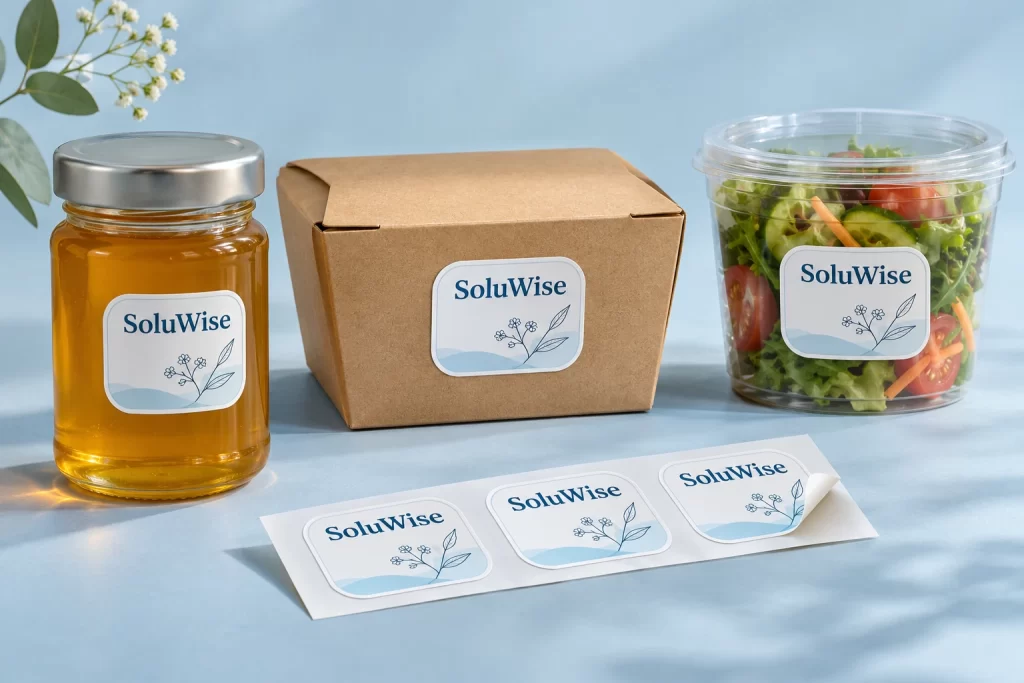
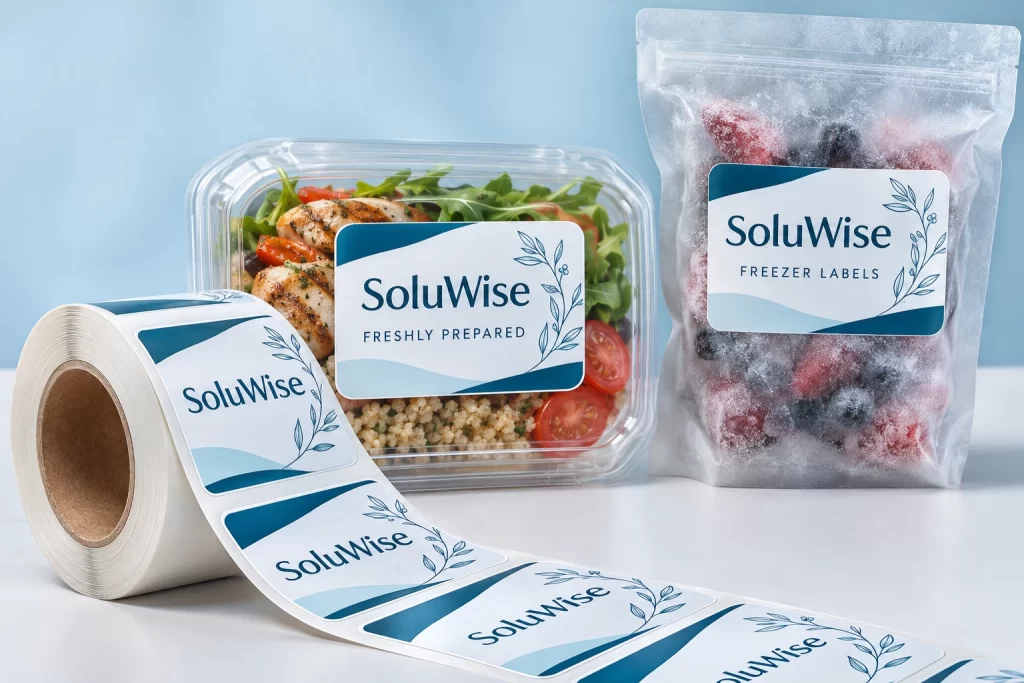
Food labels for every operation
From café counters to freezer shelves.
Choose food labels around how your business prepares, packs, stores and sells its products.
Café & coffee shop labels
Create a consistent look across takeaway cups, coffee bags, sandwich packs and pastry boxes. Use brand stickers, flavour labels and clear product identification suited to your packaging.
Restaurant & takeaway labels
Plan labels for takeaway containers, delivery bags, sauces and meal boxes. Where a closure seal is needed, specify its purpose and request a suitable construction; a standard sticker is not automatically tamper-evident.
Retail & packaged food labels
Organise your product range with front, back or wraparound labels for snacks, spices, grains and ready-to-sell foods. Allow room for approved product information and individual flavours or sizes.
Frozen food & freezer labels
Specify labels for frozen meals, meat packs, frozen desserts or other freezer products. Confirm application and service temperatures, frost exposure and adhesive suitability, then test on the actual pack.
Chilled food & meal-prep labels
Label salads, dairy containers, deli tubs and prepared meals with a construction chosen for cold storage and condensation. Tell the printer whether labels are applied before or after chilling.
Bakery & confectionery labels
Bring a coordinated identity to bread bags, cake boxes, biscuit packs and sweets. Choose a compact brand seal or a larger information label to suit the shape and available space.
Sauce, honey & beverage labels
Fit labels to curved jars and bottles containing sauces, preserves, honey, oils or drinks. Consider moisture, oily handling, label overlap and visibility through clear packaging.
Coffee, nuts & snack labels
Use labels on resealable pouches and bags for roasted coffee, nuts, dried fruit and snacks. Keep the design consistent while making each variety easy to recognise.
Ingredient, allergen & nutrition labels
Set out approved ingredients, allergen declarations, nutrition content and storage information where applicable. Keep smaller text readable and allow enough space for required languages.
Barcode, batch & date layouts
Plan areas for barcodes, QR codes and batch or date information. Confirm whether variable details will be printed with the label or added later using compatible overprinting equipment.
Catering & event food labels
Identify packed lunches, snack boxes and individual food portions with clear, consistent labels. For food selection or dietary information, use verified wording and keep each label linked to the correct product.
Preparation & stock-rotation labels
Plan writable or printer-compatible labels for prep containers, internal identification and stock rotation. Discuss removability, writing surface and storage conditions to suit your kitchen workflow.
Material and adhesive suitability must be confirmed for the intended application. Specialist options are subject to the agreed production specification.
Material matters
Choose for the conditions.
Then choose the finish.
Food packaging may move from an air-conditioned stockroom to a delivery vehicle, refrigerator or retail shelf. Label performance depends on the complete combination of face material, adhesive, finish and application conditions.
| Option | Typical use | What to check |
|---|---|---|
| Paper labels | Dry food packs, boxes and ambient pantry products | Moisture exposure, scuffing and the need for a protective finish |
| White film labels | Containers where moisture resistance is important | Film type, adhesive suitability and condensation resistance |
| Clear film labels | Glass jars and bottles with a minimal, see-through look | White ink, contrast and appearance on the filled container |
| Textured or kraft-look paper | Artisan-style ranges and gift packaging | Colour reproduction, legibility and surface protection |
| Specialist cold-use construction | Chilled or frozen food packaging | Application temperature, service temperature and actual pack testing |
Matt, gloss or a natural look
Matt finishes create a restrained appearance; gloss can strengthen colour and visual contrast. A textured paper can support an artisan feel. Check the finished sample for readability, handling and compatibility with your packaging.
Rolls, sheets & custom shapes
Choose rolls or sheets to match your packing process, subject to production availability. For machine application, confirm roll direction, core diameter, maximum roll size, label gap and applicator requirements before ordering.
Clear information. Confident design.
Make room for the details that matter.
A well-designed food label makes the brand easy to recognise and the product information easy to read. Start with approved content, then build the layout around the available space.
For bilingual layouts, allow enough room for Arabic and English without squeezing text into the edges. Check right-to-left text, punctuation, numbers and line breaks with a qualified reviewer.
Print preparation and regulatory assessment are separate steps. The food business should confirm which declarations, languages, registrations and approvals apply to its product before authorising production.
For official guidance, consult Dubai Municipality’s food trader resources and the UAE Government food safety information.
From brief to finished label
A practical route to your next print run.
Resolve the packaging and artwork details before committing to production.
If you are launching a new product, share a container sample or clear photographs with measurements. If you are reordering, include the previous specification and explain anything that has changed.
Share the brief
Provide the label dimensions, quantity per design, packaging surface, storage conditions and target date.
Confirm the specification
Agree the material, adhesive, finish and delivery format. Discuss a sample trial for demanding surfaces or cold storage.
Review the proof
Check text, layout, dimensions and variable information. Use a physical sample when colour or material appearance is critical.
Approve the order
Confirm the final artwork, commercial terms, production schedule and collection or delivery arrangements in writing.
A quote built around your order
What affects food label printing prices?
Two labels with the same dimensions can cost different amounts because the material, finish and production setup differ. A useful quotation starts with a clear specification rather than a generic price per sticker.
When comparing quotations, check that they cover the same material, quantity per design, finishing and supply format. Ask whether artwork work, setup, VAT and delivery are included or quoted separately.
Include these details for accurate pricing
- Finished width and height, shape and number of designs
- Quantity for each product or flavour
- Material, adhesive and finish preferences
- Roll or sheet supply and application method
- Artwork readiness and any variable data
- Required date and delivery location in Dubai or elsewhere in the UAE
Minimum quantities, sample availability and turnaround times depend on the confirmed specification and production capacity.
Dubai & UAE orders
Plan labels around your local operation.
Whether you are preparing a retail launch, refreshing a café range or coordinating a food production run, start with the practical details of your Dubai operation.
Include your delivery area and packing location when you enquire—for example, Al Quoz, Dubai Investment Park, Jebel Ali or another Dubai community. For orders elsewhere in the UAE, provide the emirate and delivery address so availability, timing and charges can be confirmed.
For local retail, hospitality and online food sales, keep the product identity consistent across packaging sizes and flavours. A planned label system makes it easier to manage repeat orders and update individual products without redesigning the whole range.
Before you print
Food label printing FAQs
Which label material is best for chilled food?
The right construction depends on the packaging surface, moisture exposure, temperature during application and temperature during storage. A suitable film and adhesive may be appropriate, but confirm the specification and test it on a filled pack under realistic conditions.
Can food labels be printed in Arabic and English?
Bilingual artwork can be prepared for printing. Confirm production support for your design, provide approved Arabic and English content, and have the final language layout reviewed before print approval. The information required depends on the product and applicable rules.
Do printed labels automatically meet Dubai Municipality requirements?
Printing a label does not provide regulatory approval. The food business remains responsible for accurate content and any applicable product registration or label assessment. Confirm the current requirements with the relevant authority before printing.
Can I use the same label for chilled and frozen products?
Do not assume one construction will work for both. State whether labels will be applied before chilling, to a cold container or to a frozen pack. Adhesive performance and moisture exposure differ across these conditions.
What artwork files should I prepare?
A print-ready PDF with embedded or outlined fonts is usually a practical starting point. Ask for the printer’s exact requirements for bleed, safe margins, cut lines, colour mode, image resolution and white ink before exporting the final artwork.
Can labels include barcodes, QR codes and batch information?
These elements can be included in the artwork or planned for later overprinting, depending on the agreed production method. Supply accurate data, preserve sufficient clear space and test scans on the final printed packaging.
What is the minimum order quantity?
Minimum quantities vary by label size, material, number of designs and production method. Share the quantity needed for each SKU and ask for suitable options for a first run and repeat orders.
How long does food label printing take in Dubai?
A reliable schedule can be confirmed after reviewing the specification, artwork approval, material availability and order volume. Include your required date in the brief and confirm production and delivery timing before placing the order.
Are the labels suitable for direct contact with food?
Direct food contact requires a specifically suitable construction and supporting documentation for the intended use. Do not assume an exterior packaging label is suitable for direct contact. Explain the application and request confirmation before ordering.
Your next pack starts here
Let’s get your food labels ready.
Share your packaging, label dimensions and quantities to start a clear, practical conversation about your print specification.
Include your artwork if it is ready, along with your required date and delivery location. For chilled or frozen products, tell us how the labels will be applied and stored.
Have several flavours or sizes? Include a quantity breakdown for each design.
Not Sure What You Need?
Contact us below, & one of our experts will get in touch with you shortly
Contact Us