
For most businesses, the right question is not simply “what is the cheapest label?” It is which label will scan reliably, remain attached for its required life and work with the available printer or application process. A low initial custom barcode labels price in the UAE can become expensive if labels curl, fade, lift from cartons or fail to scan during receiving.
A practical purchasing decision starts with the application. Warehouse carton labels, retail product stickers, asset tags, chilled goods and laundry items experience very different handling conditions. The label material and print method should match those conditions before a supplier can provide a meaningful quotation.
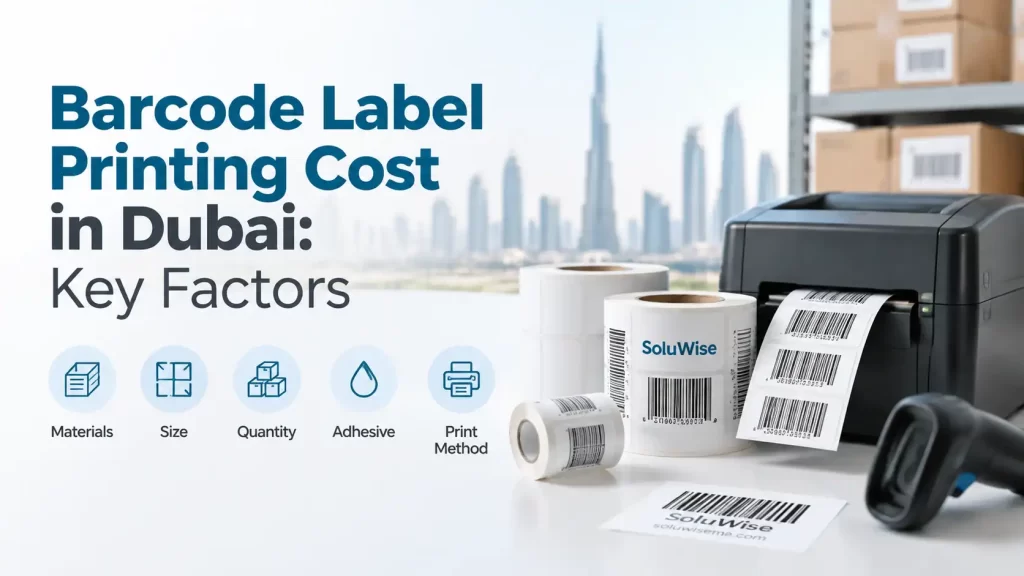
What affects barcode label printing cost in Dubai?
Barcode label printing cost in Dubai is normally shaped by the physical construction of the label, the print work required and the volume ordered. Two labels with the same face size can have very different costs if one is a plain paper shipping label and the other needs a durable synthetic face stock, permanent adhesive, variable serial numbers and protective finishing.
For commercial buyers, the most useful approach is to define the label’s job first: what it identifies, where it will be applied, how long it must remain readable and how it will be scanned. That information helps avoid comparing quotations that are not genuinely equivalent.
1. Material and label construction
Material is often one of the largest influences on barcode sticker printing Dubai requirements. Standard paper labels are commonly suitable for indoor cartons, short-life inventory identification and dry retail applications. They may be less suitable where labels face repeated abrasion, moisture, oils, cleaning chemicals or prolonged outdoor exposure.
Synthetic materials can be considered where greater resistance is needed, such as on reusable bins, equipment or items stored in warm, humid areas. A more durable face stock may cost more than paper, but it can reduce relabelling and scanning problems in demanding applications. The required durability should be specified rather than assumed.
2. Dimensions, shape and label layout
Label width and height directly affect material usage and the number of labels that fit across a roll or sheet. Larger labels require more stock, while unusual shapes may introduce additional converting work. Small labels can also become more demanding if the barcode, text and serial information must remain legible at a reduced size.
The barcode itself needs enough quiet zone around it and a suitable module size for the intended scanner and printing method. Trying to place a dense barcode, logo, product description and multiple languages on a very small label can create readability risks. In those cases, a modest increase in label size may be more economical than repeated failed scans.
3. Order quantity and repeat frequency
Barcode labels bulk printing usually lowers the unit cost because setup, artwork review and production preparation are spread over more labels. That does not automatically make the largest order the right choice. Businesses should balance the unit saving against storage space, expected product changes and the risk of keeping outdated labels.
For a stable carton-label format used throughout the year, a larger order may make sense. For seasonal retail stock, changing product information or labels with variable data, shorter batches can be more appropriate even if the unit price is higher.
4. Adhesive choice and application surface
Adhesive selection should match both the surface and the environment. Clean corrugated cartons, smooth plastic containers, curved bottles, chilled packaging and rough painted equipment can all need different adhesive behaviour. A label that adheres well to one surface may not perform as expected on another.
Purchasers should state whether the label needs to be permanent, removable or repositionable. They should also identify the application temperature and any exposure to cold storage, humidity, dust or handling. In UAE warehouse settings, heat during storage or transport can make surface preparation and adhesive selection particularly relevant.
5. Colours, artwork and print coverage
A simple one-colour barcode and text design is generally less complex than a label with multiple colours, large solid areas, photographs or detailed branding. Colour requirements may affect the print process, setup and production route. Heavy ink coverage can also affect how a barcode is positioned and how reliably it scans.
For operational labels, contrast should be prioritised over decoration. A dark barcode on a light, non-reflective background is often easier to scan than artwork that crowds the code or uses low-contrast colours.
Print method: direct thermal versus thermal transfer labels
The print method influences both thermal labels cost and the likely service life of the printed image. It is not only a printer decision; it affects label material selection, consumables and the suitability of the finished barcode for its working environment.
| Option | How it works | Common fit | Key limitation |
|---|---|---|---|
| Direct thermal labels | Heat creates an image directly on a heat-sensitive label surface. | Short-life shipping, dispatch and temporary warehouse labels. | Heat, light, friction and time can affect image durability. |
| Thermal transfer labels | A heated printhead transfers ribbon onto the label surface. | Longer-life inventory, asset, product and operational identification. | Requires a compatible ribbon and adds consumable selection. |
| Custom barcode labels | Labels are pre-printed with required artwork, codes or fixed information. | Consistent, repeat-use designs and labels needing professional pre-printing. | Less flexible if information changes frequently. |
Direct thermal labels suit applications where the barcode is needed for a short, defined period. A dispatch label moving through a normal delivery cycle is a typical example. They can be an economical choice when the label will not be exposed to high heat, direct sunlight, extended storage or frequent rubbing.
Thermal transfer labels are generally better suited to labels that must stay readable for longer or face more demanding handling. They are a sensible option for inventory bins, equipment identification, product labels and other applications where the image needs greater resistance. The label and ribbon should be selected together, because the wrong ribbon-material pairing can produce poor print quality or inadequate durability.
Custom barcode labels are useful when the design, barcode content and layout are stable. They can include fixed product information, branding or pre-assigned codes, reducing the need to print each label in-house. They are less suitable where each label needs changing serial numbers, batch data or dates unless the variable information is added later with a compatible printer.
Variable data can change the quotation scope
Variable data includes serial numbers, batch references, expiry dates, asset IDs, sequential numbers and changing product details. It adds a production and data-management consideration beyond the label artwork itself. A supplier will need to know whether the data is supplied as a clean file, whether numbering must follow a sequence and whether barcode values must be encoded from that data.
Barcode printing should also be kept separate from barcode registration. Printing a barcode symbol does not create a GS1-issued identifier, register a product or confirm compliance with a retailer’s requirements. Businesses using GS1 numbers should provide the correct data and confirm their own numbering obligations before production begins.
Finishing, durability and lead-time requirements
Finishing requirements can affect cost where labels need special shapes, protective layers, perforations, roll orientations or other handling features. A roll intended for automated application may need a particular unwind direction or core arrangement. These details should be agreed before production, because they affect how labels run through printers and applicators.
Durability expectations should be written in practical terms. “Long lasting” is too vague for a useful quotation. A better description would be: “Applied to plastic warehouse totes, stored indoors, handled daily, barcode must remain readable for twelve months.” For laundry or textile environments, mention repeated washing, drying, pressing and chemical exposure rather than assuming a general-purpose barcode sticker will work.
Lead-time needs can also influence the available production approach. Artwork approval, material availability, setup requirements and quantity all affect scheduling. Buyers should share the required date early but avoid treating an unconfirmed date as a guaranteed production or delivery commitment.
Illustrative label scenarios without price assumptions
These examples show why two requests described as “barcode labels” may receive very different quotations. They are not price estimates.
Warehouse carton identification
A distribution business needs 100 mm by 150 mm labels for dry corrugated cartons, carrying a bold barcode and handling information. If the labels are used for a short dispatch cycle, direct thermal labels may be appropriate. The quote will depend on roll quantity, label size, adhesive, printer compatibility and whether the company prints the labels itself or requires pre-printed labels.
Retail product labels
A retailer needs smaller labels with product codes, a brand colour and readable barcodes for shelf handling. The material may be selected around the packaging surface, expected shelf life and print coverage. If product details change often, blank labels printed in-house may offer more flexibility than a large run of pre-printed stock.
Reusable warehouse bins or equipment
A facility needs labels that remain readable on plastic bins or equipment that is handled repeatedly. Thermal transfer labels with an appropriate durable material and ribbon combination may be considered. The quotation will be affected by the surface condition, barcode size, required lifespan, abrasion exposure and any need for a protective finish.
Laundry and hospitality identification
Labels used on textiles or in laundry processes have a distinctly different requirement from carton labels. Repeated washing, heat and chemical exposure should be disclosed at quotation stage. A conventional paper label designed for warehouse cartons would be unsuitable for this use.
What to include in a barcode label quotation request
A clear request helps suppliers recommend the right construction instead of quoting a generic label that may not fit the task. It also makes competing quotations easier to compare.
- Application: State what the label identifies and where it will be used.
- Surface: Describe the item surface: carton, plastic, glass, metal, textile or another material.
- Label size and shape: Provide dimensions, orientation and any corner or die-cut requirement.
- Quantity: Give the required number of labels, number of designs and expected repeat order pattern.
- Print details: Confirm colours, artwork, barcode type, text and whether data changes per label.
- Printer and consumables: State whether labels will be pre-printed or printed in-house, plus the printer type if known.
- Environment: Mention heat, humidity, cold storage, sunlight, abrasion, oils, cleaning chemicals or laundering.
- Adhesive and lifespan: Specify permanent, removable or repositionable needs and the expected readable life.
- Roll requirements: Include core size, roll diameter, label gap, winding direction or applicator requirements where relevant.
Common mistakes that make labels cost more later
- Ordering by size alone: A dimension without material, adhesive and environment details does not define the required label.
- Using direct thermal for a long-life application: It may save initially but create fading or scan failures later.
- Ignoring printer compatibility: Label width, media sensing and ribbon requirements should fit the installed printer.
- Making barcodes too small: Dense data on a small label can reduce print tolerance and scanning reliability.
- Not approving artwork carefully: Check barcode content, human-readable text, sequence rules and layout before production.
- Assuming a printed code is registered: Barcode artwork and GS1 number allocation are separate matters.
Frequently asked questions
Why do two barcode label quotations have different prices?
The requests may differ in material, adhesive, label dimensions, print colours, data requirements, quantity, finishing or production method. Compare the full specification, not only the per-label figure.
Are direct thermal labels cheaper than thermal transfer labels?
They can be economical for short-life applications because no ribbon is used. However, thermal transfer may be the better value where labels need longer print durability or face friction, heat or handling.
Does ordering more labels always reduce the total cost?
It often reduces the unit cost, but the total invoice rises with quantity. Larger runs make most sense for stable designs that can be stored and used before specifications change.
Can a supplier print sequential barcode numbers?
Variable numbering can be part of a label project, but the required sequence, data format and barcode symbology should be specified clearly. Buyers should verify the source and validity of any identifiers they provide.
What information is needed for a custom barcode label quotation?
Provide size, quantity, application surface, environment, adhesive preference, artwork, barcode data, colour requirements, print method and any printer or roll-format constraints.
Do barcode labels need to be tested before a large order?
For demanding surfaces or environments, checking a sample or trial run can be sensible. This is especially useful for labels exposed to moisture, heat, abrasion, cold storage or repeated handling.
Before placing an order, confirm the label’s job, its working conditions and how it will be printed or applied. A well-defined specification helps control barcode label printing costs in Dubai while avoiding false savings from labels that do not remain readable or attached for the required period.


