
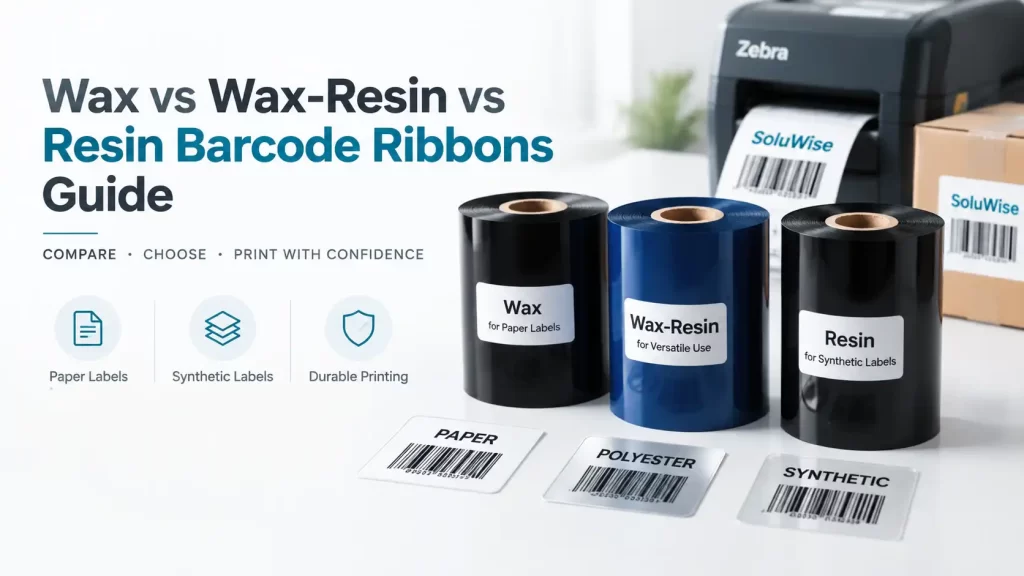
Choosing between barcode ribbon types affects more than print appearance. The wrong ribbon can produce barcodes that smudge during handling, fade on unsuitable label stock or fail to scan after exposure to heat, cleaning products or abrasion.
For most businesses, the decision comes down to the label material, the working environment and how long the printed information must remain readable. Wax ribbons suit many paper-label jobs, wax-resin ribbons provide a useful middle ground, and resin ribbons are intended for demanding synthetic-label applications.
Start with the printing method: thermal transfer versus direct thermal
Thermal transfer printing uses a ribbon. The printer heats the ribbon and transfers its ink coating onto the label surface. This method is commonly used where labels need better durability, variable data or compatibility with paper and synthetic materials.
Direct thermal printing does not use a ribbon. Instead, it prints directly onto heat-sensitive label material. It can be practical for short-life uses such as temporary dispatch labels, but direct thermal labels may darken or lose readability when exposed to heat, sunlight, friction or long storage periods.
If the printer is a thermal transfer model, selecting the correct ribbon is as important as selecting the label. Barcode ribbon compatibility depends on the printer, ribbon width, winding direction, label face stock and the conditions the label will face after printing.
Barcode ribbon types at a glance
| Ribbon type | Typical label materials | Durability level | Common uses | Main limitation |
|---|---|---|---|---|
| Wax ribbon | Uncoated and coated paper labels | Moderate for dry, low-abrasion handling | Retail labels, carton labels, shelf labels, warehouse identification | Less suitable for chemicals, heavy rubbing and synthetic materials |
| Wax-resin ribbon | Coated paper and many synthetic labels | Higher resistance to smudging and abrasion | Product labels, logistics labels, inventory labels, general industrial use | May not withstand the harshest chemical or outdoor conditions |
| Resin ribbon | Synthetic materials such as polypropylene and polyester | High resistance to abrasion, moisture and many chemicals | Asset labels, industrial identification, chemical exposure, long-life labels | Higher cost and requires suitable label material and printer settings |
Wax ribbons: practical for everyday paper barcode labels
Wax ribbons are generally the starting point for standard paper barcode labels. Their softer ink formulation transfers well at relatively lower energy settings and is often appropriate for indoor labels that will not receive excessive rubbing or chemical exposure.
They are a sensible choice for warehouse carton labels, retail price labels, shelf-edge labels and internal stock identification where the label is handled normally and stored in dry conditions. For a distributor printing barcode labels for cartons moving from a warehouse to a local customer, wax can offer readable print at an appropriate cost level.
Wax ribbons are less suitable where labels are likely to rub against equipment, be wiped repeatedly or encounter oils, solvents, cleaning agents or persistent humidity. A wax print may look sharp at the printer but lose definition if the real-world application is more demanding than expected.
Who should choose wax ribbons?
- Retailers printing paper price, shelf or product labels for indoor use.
- Warehouses printing carton and pallet labels with a limited handling cycle.
- Businesses using standard paper labels for internal inventory control.
- Operations where low-to-moderate print durability is acceptable.
Wax-resin barcode ribbon: the versatile middle option
A wax-resin barcode ribbon combines the easy-printing characteristics of wax with greater durability from resin. It is often selected where a standard wax ribbon may smudge too easily, but a full resin ribbon would be unnecessary or unsuitable for the label material.
This option works well for coated paper labels and many synthetic label applications, subject to testing. It is a practical choice for product identification, stock labels, logistics labels and warehouse labels that may face more handling, light abrasion or variable temperatures.
For UAE operations, wax-resin can be useful where labels travel through busy warehouses, loading areas or retail back rooms. Heat and humidity alone do not automatically require resin, but they should prompt a review of label adhesive, face material and the likely handling conditions.
When wax-resin is a better fit than wax
Choose wax-resin ribbons where printed barcodes or text need stronger resistance to rubbing, scuffing or ordinary handling. For example, a label on a plastic tote, a packaged product or a stock item that moves through several picking stages may benefit from the more durable print.
It is still important to test the ribbon with the actual label. A wax-resin ribbon may perform very differently on matte paper, gloss-coated paper, polypropylene or polyester. Print darkness, speed and heat settings should be adjusted as a combination rather than assumed from the ribbon type alone.
Resin ribbons: for synthetic labels and demanding environments
Resin ribbons use a harder ink coating that bonds strongly to suitable synthetic label surfaces. They are selected for labels that need higher resistance to abrasion, moisture, cleaning agents and, depending on the ribbon-label combination, certain chemicals.
Typical applications include asset identification, equipment labels, industrial product labels, laboratory-style identification, outdoor-adjacent equipment marking and labels exposed to repeated cleaning. A resin ribbon is also commonly considered where barcodes must remain readable over a long service life rather than only during shipping or short-term storage.
Resin is not automatically the right choice for every durable-looking job. It generally costs more than wax or wax-resin, and it needs the correct label surface to achieve good adhesion. Using resin on an unsuitable paper label can produce disappointing results and wastes the benefit of the more durable ribbon.
Who should choose resin ribbons?
- Manufacturers applying labels to equipment, components or industrial containers.
- IT teams printing long-life asset labels on compatible synthetic materials.
- Businesses needing labels that tolerate repeated wiping or rough handling.
- Laundries and hospitality operations using suitable synthetic identification labels for repeated-use environments.
Wax ribbon vs resin ribbon: how durability changes the decision
The main difference in the wax ribbon vs resin ribbon decision is the level of resistance required after printing. Wax is usually appropriate for ordinary paper labels in controlled indoor environments. Resin is intended for much tougher applications on compatible synthetic materials.
Wax-resin sits between them. It often gives a better balance where print must survive regular handling but does not face aggressive chemicals or prolonged abrasion. Rather than choosing by ribbon cost alone, businesses should consider the cost of relabelling, scan failures and manual rework if a print rubs off too soon.
Match the ribbon to the label material
Ribbon chemistry and label material should be selected as a pair. A paper shipping label and a polyester asset label have very different surfaces, durability requirements and likely print settings.
- Uncoated paper: Often suitable for wax ribbons where handling is limited.
- Coated paper: May suit wax or wax-resin, depending on the coating and required resistance.
- Polypropylene: Often paired with wax-resin or resin, depending on use conditions.
- Polyester: Commonly considered with resin ribbons for long-life identification needs.
- Fabric and laundry label materials: Need application-specific testing because washing, heat and friction place unusual demands on print and material.
A sample print test is useful before committing to a large production run. Check barcode scan quality, text sharpness and resistance to the actual conditions the label will experience. Rub testing, wipe testing and exposure to expected cleaning materials can reveal a poor match early.
Printer compatibility, ribbon width and winding direction
Even the correct ribbon type will not work properly if it does not fit the printer. Thermal transfer printers use specific core sizes, ribbon lengths, coating positions and winding directions. A ribbon wound for one printer arrangement may not print correctly in another.
Zebra thermal transfer printers, like other barcode printer brands, require ribbons that match the relevant printer design and label setup. The printer documentation and existing ribbon specification are useful starting points, but the application still determines whether wax, wax-resin or resin is appropriate.
Ribbon width should normally be at least as wide as the label and print area. A ribbon that is too narrow can leave parts of the printhead exposed to label abrasion, which may contribute to premature printhead wear. Excessively wide ribbon can be wasteful, so the practical goal is suitable coverage without unnecessary material use.
Common ribbon-selection mistakes
- Choosing by price only. The lowest-cost ribbon can become expensive if labels smudge, fail scanning checks or need replacement.
- Using resin on the wrong stock. Resin needs a compatible label surface; it is not a universal upgrade.
- Ignoring the environment. Cold storage, heat, humidity, cleaning routines and abrasion should be assessed before ordering.
- Assuming every printer uses the same ribbon. Core size, winding and coating orientation matter.
- Printing too fast or too lightly. Poor darkness and weak transfer can result from unsuitable speed and heat settings, even with the right ribbon.
- Skipping a test label. A small trial with the actual label, printer and handling process can prevent a costly mismatch.
How to select thermal transfer ribbons for your application
Start by defining how long the label must remain readable and what it will encounter. A carton label used for a few days has a different requirement from an asset label expected to remain on equipment for years.
- Identify the label material: paper, coated paper, polypropylene, polyester or specialist fabric material.
- List the likely exposure: rubbing, moisture, heat, sunlight, cleaning agents, oils or repeated washing.
- Confirm the printer make, model, ribbon core and winding requirements.
- Measure the label width and choose a ribbon that fully covers the print area.
- Print samples and test barcode readability after realistic handling.
- Adjust print speed and darkness before concluding that a ribbon is unsuitable.
For many standard indoor paper labels, wax ribbons are appropriate. For more frequent handling or coated materials, wax-resin ribbons are often a balanced option. For synthetic labels facing demanding conditions, resin ribbons should be evaluated with the intended label stock.
Frequently asked questions
Can a wax ribbon print on synthetic labels?
It may print on some synthetic label materials, but print adhesion and durability can be limited. Wax-resin or resin is often more suitable where the synthetic label will be handled, wiped or exposed to moisture.
Is resin ribbon always more durable than wax-resin?
Resin generally offers higher resistance on compatible synthetic label materials. However, actual performance depends on the specific ribbon, label surface, print settings and exposure conditions.
Can the same thermal transfer ribbon work in every printer?
No. Ribbon width, core diameter, length, winding direction and coating orientation must match the printer. Check the printer requirements before purchasing.
Why do printed barcodes smudge even with a new ribbon?
The ribbon may be too soft for the label or application, the print darkness may be too low, or the label surface may not be compatible. Excessive print speed and a dirty printhead can also affect transfer quality.
Do thermal transfer ribbons make a barcode GS1 registered?
No. A ribbon prints barcode symbols and human-readable information. GS1-issued identifiers, product registration and barcode data management are separate matters from printing labels.
What ribbon is suitable for warehouse labels in the UAE?
For standard indoor carton and inventory labels, wax or wax-resin may be appropriate depending on handling. Where labels face heavier abrasion, moisture or synthetic surfaces, resin may be a better candidate after testing.
The most reliable choice comes from assessing the complete print system: printer, ribbon, label material, print settings and working environment. A good sample should remain legible, scan consistently and meet the expected life of the label without paying for resistance the application does not need.