
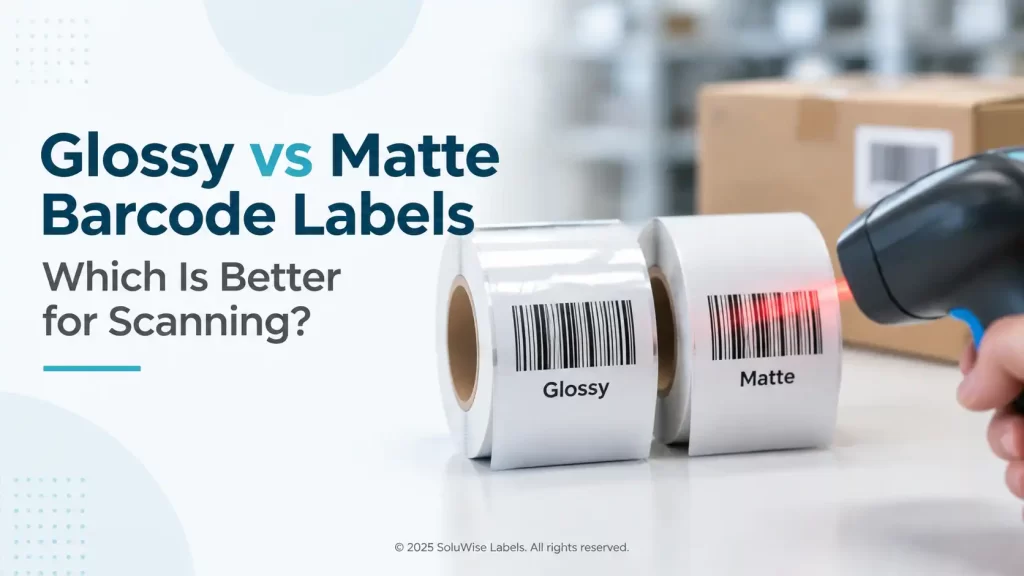
Choosing between glossy vs matte barcode labels is not only an appearance decision. The surface finish can affect how reliably a scanner reads the code, how easily staff can write on the label and how well it copes with fingerprints, scuffs and routine handling.
For most operational barcode applications, matte is the safer starting point because it reduces glare and is easier to scan from different angles. Glossy labels can still be a good choice where presentation matters and the label will be scanned under controlled lighting. The right answer depends on the barcode size, printer, label material and working environment.
Businesses in Dubai, Abu Dhabi and across the UAE often use labels in bright retail areas, warehouses with strong overhead lighting and logistics operations where cartons are handled repeatedly. In those conditions, the finish deserves as much attention as the adhesive and label material.
Glossy vs Matte Barcode Labels: the practical verdict
Choose matte labels for general-purpose barcode scanning, warehouse identification, asset tracking, shipping cartons and labels that may need handwriting. Their low-reflective surface is usually more forgiving under varied lighting and during fast-paced scanning.
Choose glossy labels where a polished visual finish is valuable, such as consumer-facing retail packaging, promotional products or branded product labels. They can scan well, but barcode design and lighting need more care because a shiny surface may reflect scanner light.
| Factor | Matte barcode labels | Glossy barcode labels |
|---|---|---|
| Scanning under overhead light | Usually easier because there is less glare | Can be affected by reflected light and scanning angle |
| Appearance | Low-sheen, practical and professional | Smooth, shiny and more presentation-led |
| Writing by hand | Generally more suitable for pen markings | Ink may smudge or take longer to dry, depending on the pen |
| Fingerprints and visible marks | Usually hides fingerprints better | May show fingerprints, scratches and scuffs more clearly |
| Typical applications | Cartons, shelves, assets, inventory and work-in-progress | Retail packs, product presentation and display-facing labels |
| Environmental suitability | Depends on the material and adhesive, not finish alone | Depends on the material and adhesive, not finish alone |
Why barcode label finish affects scan readability
A barcode scanner needs a clear contrast between the bars or modules and the background. The printed code, its size, quiet zones and print quality are central to reliable reading. However, the barcode label finish can change how light reflects off that printed surface.
Glossy labels reflect more light. If a scanner, mobile device camera or overhead light catches the reflection at the wrong angle, the bright glare can partly obscure the barcode to the reader. This does not mean glossy labels are inherently unscannable; it means they are less tolerant of poor lighting, curved surfaces or hurried scanning from inconsistent angles.
Matte labels diffuse light rather than producing a concentrated reflection. That makes them a practical choice for warehouse teams scanning cartons on racks, staff scanning asset labels at desks or retail employees using handheld devices under ceiling lights.
Print quality still matters more than finish alone
A matte surface cannot compensate for a poorly printed barcode. Faded print, excessive darkness, damaged bars, inadequate contrast or a barcode that is too small can cause failures on either finish. Likewise, a well-produced glossy label may scan consistently in the right environment.
Before committing to a large run, print samples at the intended label size and test them with the actual scanner or mobile device used by staff. Test at normal working distances, not only at a desk under ideal lighting. This is particularly useful where codes will be placed on shrink wrap, glossy packaging or curved containers.
Matte labels: best for operations, handling and mixed lighting
Matte labels are often the practical choice for internal business processes. Their understated appearance suits stock identification, bin labels, warehouse cartons, office equipment, spare parts and work-in-progress tracking. They are also easier for staff to annotate with dates, batch notes or inspection marks where handwriting is part of the process.
For ordinary indoor applications, SoluWise paper labels are a sensible option. Paper labels suit businesses that need cost-conscious labels for cartons, shelf locations, inventory movement and short-to-medium-term identification in dry conditions. A matte paper finish is especially useful where scan consistency matters more than a premium retail appearance.
Paper has limitations. It can tear, absorb moisture and become damaged by rough handling or prolonged exposure to damp conditions. In a chilled area, a humid loading bay or an application where labels will be rubbed frequently, a paper label may not be the appropriate material even if the matte finish is ideal for scanning.
Common matte-label applications
- Warehouse carton and pallet identification where labels are scanned from several angles.
- Shelf, bin and inventory labels in stockrooms and retail back offices.
- Asset tags for computers, tools and office equipment used indoors.
- Production-stage and work-in-progress labels that staff may annotate manually.
- Dispatch labels where presentation is secondary to fast, repeatable scanning.
Glossy labels: best where visual presentation is part of the job
Glossy labels have a clean, polished look that can complement retail packaging and product-facing applications. They can make colour graphics and branding appear more vivid, although the actual result also depends on the print method, artwork and material selected.
For a product displayed under controlled lighting, a glossy label may be entirely appropriate. The barcode should be positioned away from strong highlights where possible, printed with clear dark-to-light contrast and tested after application to the actual packaging. This is particularly relevant for labels applied to curved bottles, jars or glossy boxes.
Glossy labels are less suitable for labels handled constantly by warehouse staff or scanned quickly under mixed lighting. They can also show fingerprints and surface scratches more readily than matte alternatives. If the label’s main job is to identify stock rather than support a product presentation, the visual benefit may not justify the extra scan-risk consideration.
Smudge resistance: separate the finish from the label material
It is easy to assume that glossy means durable and matte means fragile. In practice, smudge resistance depends on several linked choices: the label material, adhesive, print technology, ribbon selection where applicable, curing or drying behaviour and exposure to abrasion, chemicals or moisture.
A glossy paper label may still be unsuitable for wet or abrasive use. A matte synthetic label may be far more durable than either paper option. The finish influences surface feel and reflection, but it does not by itself define the label’s resistance to water, oils, cleaning products or repeated handling.
For harsher environments, SoluWise synthetic labels should be considered. Synthetic labels suit applications where paper could tear or deteriorate, such as equipment identification, industrial items, outdoor-adjacent storage, damp areas or products exposed to routine wiping. They can be supplied in different finishes, so the finish should be selected alongside the required durability rather than treated as a separate afterthought.
Even synthetic labels have limits. The appropriate choice depends on the surface, temperature at application, exposure conditions and the adhesive needed. A label intended for an indoor asset may not suit a frequently washed item, a heavily textured surface or a container exposed to strong chemicals without application-specific testing.
Choose a printer that supports consistent barcode output
Label finish works best alongside clear printing and a suitable label format. For teams producing barcode labels in-house, desktop barcode printers can be considered for routine labelling tasks where the printer, consumables and application are matched carefully.
See SoluWise’s desktop barcode printer options in Dubai and the UAE to discuss a setup suited to the labels your team needs to print. SoluWise can help assess label material, print volume and barcode use before a selection is made.
Appearance versus working performance
The most attractive label is not always the most useful label. A premium-looking glossy finish may suit a retail product, while a low-glare matte label can be the better operational choice for the same business’s warehouse cartons. It is common for one organisation to use both finishes for different tasks.
For example, a retailer may use glossy labels on customer-facing packaged goods and matte labels for stock replenishment labels in the back room. A manufacturer may use a clean glossy product label on finished goods but a matte synthetic barcode label on reusable bins or equipment. Separating presentation labels from operational labels usually produces a more reliable result than trying to use one finish everywhere.
Checks to make before ordering barcode labels
- Identify the scanning environment. Consider direct sunlight, overhead LEDs, handheld scanners, fixed scanners and mobile-device cameras. Mixed lighting generally favours a matte surface.
- Consider how the label will be handled. Frequent touching, rubbing against cartons and handwritten notes tend to favour matte finishes or durable synthetic materials.
- Assess the surface. Flat cartons are more forgiving than curved bottles, textured plastics or shrink-wrapped products. Glossy labels on reflective or curved packaging need testing.
- Match the material to the environment. Use paper for suitable dry, lower-demand applications. Consider synthetic labels where moisture, tearing or abrasion is a concern.
- Check printer and consumable compatibility. Label stock must work with the intended printing process and any ribbon used. Incorrect combinations can lead to poor adhesion or print that rubs off.
- Test the finished label. Scan a printed, applied sample after it has been handled in realistic conditions. Do not assess only an un-applied label sheet.
Frequently asked questions
Are matte labels easier to scan than glossy labels?
Often, yes. Matte labels produce less glare, so they are usually more forgiving under changing overhead lighting and varied scanner angles. Barcode size, contrast and print quality still have a major influence on scan results.
Can glossy barcode labels be used for retail products?
Yes. Glossy labels can suit retail packaging where a polished appearance is wanted. The barcode should be printed clearly and tested on the final package, especially if the package itself is shiny or curved.
Do glossy labels resist smudging better?
Not necessarily. Smudge and abrasion resistance depend primarily on the material and printing method. A synthetic label may be more suitable than paper for demanding applications regardless of whether it has a matte or glossy finish.
Can staff write on glossy labels?
They can, but ordinary ink may not adhere well or may smudge. Matte labels are generally more practical where workers need to add dates, quantities or inspection notes by hand.
Which finish is better for warehouse barcode labels?
Matte is usually the better choice for warehouse labels because it reduces reflections and works well for routine scanning. If the warehouse has moisture, heavy abrasion or frequent handling, the material should also be reviewed, with synthetic labels often worth considering.
Does printing a barcode make it GS1 registered?
No. Printing a barcode label creates a scannable symbol, but it does not register a product or issue a GS1 identifier. Barcode number allocation and product registration are separate matters from label printing.
A simple decision rule
Select matte labels when operational scanning, handwriting and low glare are the priority. Select glossy labels when presentation is important and the final barcode can be tested under the lighting and scanning conditions it will face. For wet, abrasive or demanding environments, first choose the right material, then choose the finish.
If the choice is unclear, contact SoluWise with the label size, surface type, expected print volume, printer method and working conditions. A small sample test can help confirm whether paper or synthetic labels, and matte or glossy finish, are appropriate for the application.


