
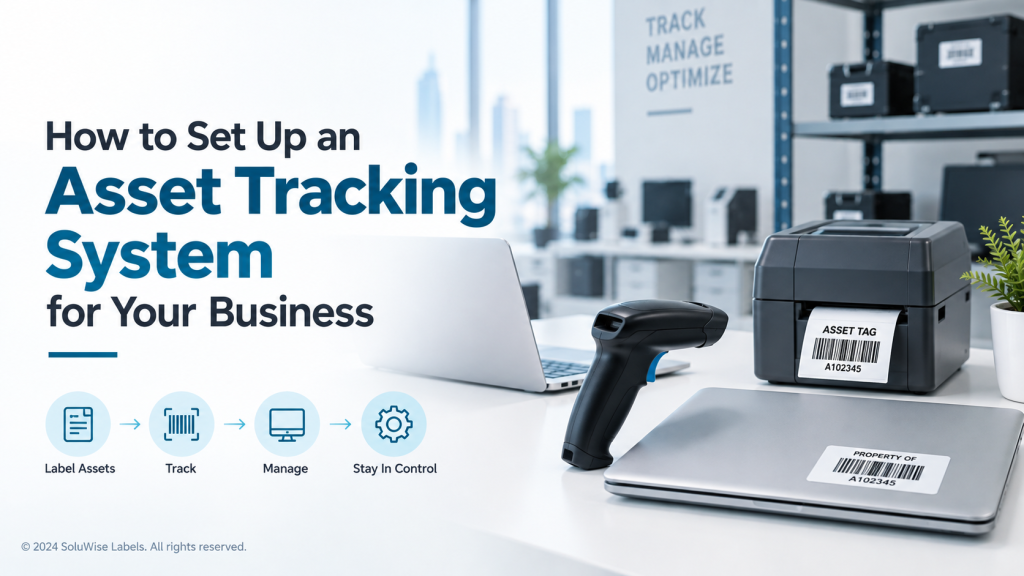
Choosing how to track assets can be challenging, especially in the climate and logistics landscape of the UAE. For many UAE businesses—whether a Dubai warehouse, a hotel, a manufacturing plant, or a laundry service—the right asset tracking system reduces lost equipment, speeds audits, and improves overall operations. In this guide, you’ll learn a practical, field-tested approach to setting up an asset tracking system from scratch, including labeling, numbering, database considerations, scanning workflows, and regular audits. The aim is to help you select a solution that works now and scales with your growth, using SoluWise assets labeling and barcode solutions as a coherent part of your toolkit.
Direct answer / overview
At a high level, an effective asset tracking system in the UAE follows a simple sequence: define each asset, assign a unique identifier, attach durable asset labels, store the identifiers in a central database or software, implement a barcode scanning workflow, and perform routine audits to keep data accurate. The system should be durable enough for UAE environments (heat, humidity, dust) and designed to integrate with your existing operations, whether you are tracking laptops in an IT department, pallets in a warehouse, or equipment on a manufacturing line. The key is to start with a clear scope, choose labeling materials suited to your environment, and pick software that fits your workflow.
Key factors to consider
Asset types and labeling needs
– Start by listing all asset categories you want to track: equipment, tools, furniture, vehicles, inventory items in transit, and IT devices. Each category may require different label sizes or materials. For example, durable asset labels with strong adhesive are often needed for equipment that moves through warehouses or servicing environments.
– Decide on the level of detail. A simple serial number might be enough for some assets, while others may require asset type, location, owner department, and maintenance schedule stored in the database.
Label durability and environment
– In the UAE, labels should withstand high temperatures, dust, humidity, and possible cleaning solvents. Consider thermal transfer labels with durable adhesives for outdoor or industrial use, and choose resin-coated labels if exposure is harsh.
– Select print methods and materials that match your environment. Direct thermal labels are cost-effective for short lifespans; thermal transfer labels are generally better for long-term durability.
Numbering and labeling scheme
– Use a consistent numbering scheme that is easy to read and scalable. A common approach is to assign a unique asset ID that encodes basic information (asset type, location code, year) but avoids making the ID overly long.
– Decide on a labeling convention, such as a prefix for asset type (A for assets, L for labels, S for scanners) followed by a unique number (for example, A-2026-00123). Keep it simple so maintenance teams can read and record it quickly.
Database / software considerations
– Choose a centralized asset management database or software that supports barcodes, asset life-cycle tracking, and basic workflows (check-in/check-out, maintenance, audits). Cloud-based solutions can be especially convenient for multiple UAE sites.
– Consider integration with existing ERP or inventory systems if you have them. A seamless data flow reduces duplicate data entry and errors.
– Ensure data security and user access controls to protect sensitive information.
Scanning devices and workflow
– Handheld barcode scanners or mobile devices with scanning apps speed up data capture. In environments like a busy warehouse or laundry facility, rugged scanners or mobile computers may be more reliable.
– Design the scanning workflow to minimize disruption. A typical flow includes scanning the asset when it is received, moved, deployed, or returned, followed by a quick update in the asset record.
– Implement simple validations at the point of scan (for example, matching scanned IDs to expected locations) to catch misplacements early.
Audits and governance
– Schedule regular audits—cycle counts by area or department—to keep the asset database accurate. Start with critical environments (high-value assets, high-turnover items) and expand over time.
– Use audits to identify anomalies, such as missing items or mislabeled assets, and document corrective actions.
– Maintain a change log for asset records to track who made updates and when.
Training and change management
– Train staff on labeling conventions, scanning procedures, and how to use the asset database. Short, practical training sessions with hands-on practice reduce errors.
– Create simple, visual standard operating procedures (SOPs) that employees can reference. Include common exceptions, such as re-labeling after asset repairs or transfers between locations.
Which option is right for you?
– Small business or startup (low to moderate asset count): A barcode-based system with SoluWise asset labels and a lightweight asset management software setup offers clear value. It provides accountability, easier audits, and less manual paperwork.
– Retail or hotel operations: A barcode labeling solution with durable asset labels helps keep track of equipment, devices, and service assets. A cloud-based software can give access across sites such as a reception, housekeeping, and maintenance teams.
– Warehouse or distribution center: Prioritize a robust barcode system with rugged scanners and thermal transfer labels. The workflow should support receiving, put-away, picking, and shipping, with frequent audits to maintain data accuracy.
– Manufacturing or logistics: A scalable solution that integrates with ERP or inventory systems, coupled with durable asset labels and high-volume printing capabilities, is advantageous. Regular audits and maintenance workflows reduce downtime.
– Outdoor or harsh environments: Choose weatherproof labels and adhesive designed for outdoor exposure. An asset management system that supports offline data capture can be useful for sites with intermittent connectivity.
– High-volume printing vs low-volume printing: For high-volume printing, invest in a reliable thermal transfer printer with durable labels. For low-volume needs, a direct thermal printer with appropriate label stock can be cost-effective.
Recommended SoluWise products
SoluWise offers a coherent set of solutions to implement an Asset Tracking System tailored to UAE businesses. The following product types are typically relevant in this context:
– Asset labels: Durable, weather-resistant labels designed to withstand UAE conditions, with strong adhesives suitable for metal, plastic, and outdoor equipment.
– Barcode printers: Printers capable of printing high-contrast barcodes on durable stock, with options for direct thermal or thermal transfer printing depending on expected label life.
– Barcode scanners: Handheld or mobile-scanner devices that enable fast, accurate data capture on the floor and in warehouses.
– Asset management software: A central system to store asset records, manage lifecycle events, enable check-in/out, and support audits across locations.
These components work together to deliver clear asset visibility, reduce misplacement, and simplify audits. When selecting materials and devices, consider environment, asset type, and the scanning workflow you plan to implement in your UAE operations. If you need help aligning labeling materials, printers, scanners, and software to your specific site layout and footprint, SoluWise can assist in composing a practical, scalable solution built around your asset profile.
Common mistakes to avoid
– Underestimating the importance of a naming and labeling standard. Without a consistent scheme, you’ll spend more time reconciling records than managing assets.
– Skipping durable labeling. In hot or dusty UAE environments, flimsy labels fail quickly, creating data gaps and audit issues.
– Overcomplicating the system. Start small with a well-defined scope, then expand. Complex systems can hinder user adoption.
– Not integrating with existing processes. If scanning or data entry is too burdensome, staff will bypass the system, defeating the purpose.
– Failing to train staff. Ongoing training ensures accurate data capture and consistent use of the asset management workflow.
Frequently Asked Questions
Q1: What is the main benefit of an asset tracking system for a UAE business?
A1: The main benefits are improved asset visibility, reduced losses, faster audits, and better maintenance planning, all of which translate into lower operating costs and smoother daily operations across sites in the UAE.
Q2: Do I need RFID for asset tracking, or is a barcode system enough?
A2: Barcode systems are typically sufficient for many UAE businesses, offering cost-effective scanning and good scalability. RFID can add advantages in certain high-volume, high-security environments, but it requires a broader investment and infrastructure.
Q3: How should I start labeling assets in a climate like Dubai or Abu Dhabi?
A3: Begin with a pilot in a single location or asset class, choose durable label material and printers suitable for your environment, define a simple asset ID scheme, and implement a basic database. Expand as you validate workflows.
Q4: How often should audits be performed?
A4: Start with monthly cycle counts for high-value or high-movement assets, then extend to quarterly or half-yearly audits for other categories. Document discrepancies and adjust processes accordingly.
Q5: What is the typical cost range to set up an asset tracking system?
A5: Costs vary by scope, environment, and scale. Expect investments in labels and printers, scanners, software, and training. A practical approach is to phase the rollout, starting with core assets and one site, then scale.
Q6: Can SoluWise help me choose the right label material and printer for my assets?
A6: Yes. SoluWise can assess your assets, environment, and workflow to recommend label stock, printers, and scanning equipment that fit your needs and budget in the UAE context.
Final recommendation
For most UAE businesses seeking reliable asset visibility with scalable growth, a barcode-based asset tracking system using durable SoluWise asset labels, compatible barcode printers, and a centralized asset management solution offers a balanced mix of cost, reliability, and ease of use. Start with a clear scope, standardize asset IDs and labeling, and implement a practical scanning workflow supported by regular audits. If you are unsure which label material, printer, or scanner best fits your environment, SoluWise can help design a tailored solution that matches your asset mix, location footprint, and operations tempo.


