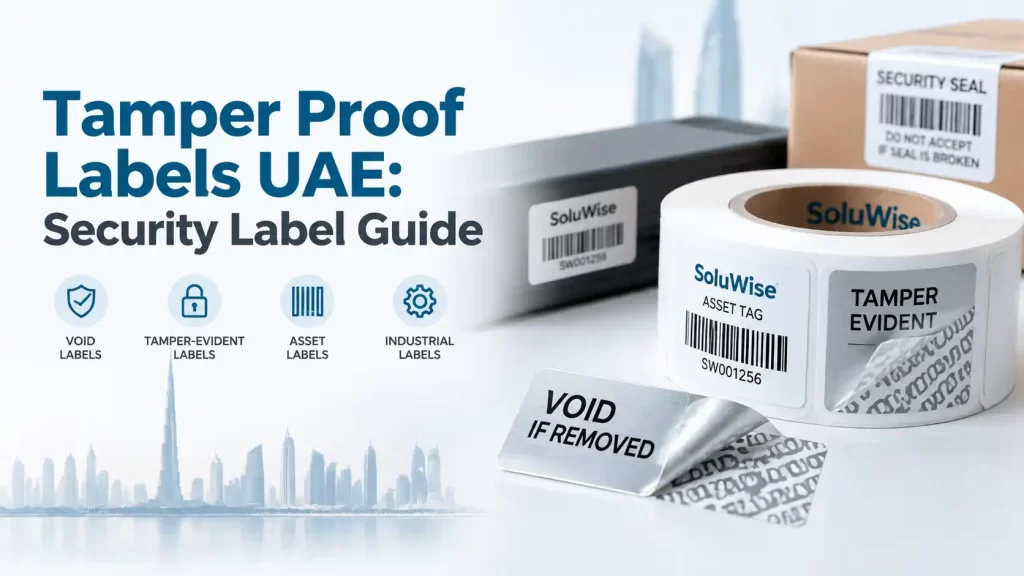
Tamper proof labels UAE businesses use are designed to show visible evidence when someone attempts to remove, open or interfere with an item. They are commonly applied to electronics, cartons, warranty points, IT assets, access-controlled equipment and sealed products.
The right label depends on what needs protecting, the surface it will be applied to and what should happen during removal. Some labels break apart, some leave a visible message or residue, and some lift cleanly while still showing that a seal has been disturbed.
A security label is not a lock, alarm or guarantee against unauthorised access. Its value is that it deters casual interference and gives staff a clear visual indication that an item may need inspection.
How Tamper Proof Labels UAE Businesses Use Actually Work
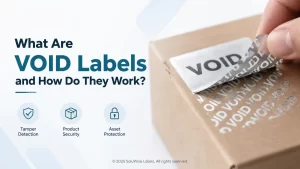
A tamper-evident label changes in a noticeable way after removal or attempted removal. That change may be a broken face material, a transferred pattern, adhesive residue or a hidden message such as “VOID” appearing on the label, surface or both.
For example, a distributor may place a security seal across the opening of an electronics carton. If the carton is opened, the seal tears or reveals a void pattern. Warehouse staff can then identify that the package should be checked before it is issued, sold or returned to stock.
“Tamper proof” is a common description, but it can be misleading if interpreted literally. No label can make an item impossible to access. A more accurate term is tamper evident: the label is intended to reveal evidence of attempted interference.
What does void label meaning refer to?
Void label meaning refers to the visible word, pattern or message that appears after the label is lifted. A void construction may leave the message behind on the application surface, show it within the label face, or do both. The exact removal effect varies by material and adhesive construction.
Void labels are useful where an intact seal matters more than preserving the original label. They are often considered for packaging, equipment covers, warranty seals and cartons moving through several handling stages.
Types of Tamper-Evident Labels and Their Uses
Security constructions should be selected by removal behaviour, surface type and the working environment. A label that works well on a clean metal enclosure may perform poorly on a dusty carton, textured plastic or low-energy surface.
| Label type | What happens on removal | Suitable applications | Key limitation |
|---|---|---|---|
| Void labels | A void message or pattern becomes visible after lifting. | Cartons, electronics covers, warranty points and sealed packaging. | Removal result can vary by substrate and adhesive bond. |
| Destructible security labels | The face material breaks into small pieces or tears. | Asset identification, product seals and warranty labels. | Usually unsuitable where the label may need to be removed intact later. |
| Residue-leaving labels | Adhesive residue or a transfer remains on the surface. | High-visibility sealing of equipment and packaging. | May require cleaning after authorised removal. |
| Clean-removal security labels | The label can lift with limited residue while still showing tamper evidence. | Reusable containers, selected access points and controlled inspections. | Not every surface or environment supports clean removal. |
Void labels for packaging and warranty seals
Void labels are a practical option where teams need a quick visual check. A retailer receiving high-value electronics, for instance, can inspect a carton seal before accepting it into inventory. If the void pattern is visible, the item can be isolated for review.
They can also be used across a warranty access point. This does not determine the terms of a warranty by itself, but it can indicate that an enclosure has been opened and may need technical assessment.
Destructible security labels for assets
Destructible security labels are designed to fragment when somebody tries to peel them off. They suit IT equipment, tools, controlled devices and other assets where transferring an identification label to another item should be difficult.
For an office IT department, a destructible label can carry an asset number and company identifier on a laptop, monitor or network device. It should be tested first, particularly on textured plastic, powder-coated metal or surfaces with oils and cleaning residues.
Residue-leaving versus clean-removal labels
A residue-leaving construction provides a conspicuous sign of removal, which can be useful on one-time seals. It may not suit premium finished surfaces, rental equipment or products that must be resold in clean condition after authorised inspection.
Clean-removal security labels are more appropriate where authorised staff may need to remove a seal without lengthy cleaning. They still require testing because heat, dwell time and the surface material can affect both adhesion and removal behaviour.
Where Security Labels UAE Organisations Commonly Apply
Security labels UAE operations use are often most effective when they support an existing process rather than replace one. A seal should be tied to receiving checks, asset records, return inspections or access-control procedures so staff know what to do when tampering is seen.
Electronics and warranty control
Electronics importers, repair centres and retailers may use tamper-evident labels over casing seams, access screws or retail packaging. The label provides a visible checkpoint for returns and internal inspection. It should not cover ventilation, legally required product markings or labels that technicians need to read.
Warehouse cartons and dispatched goods
For warehouse and free-zone logistics operations, tamper labels can seal cartons containing sensitive components, high-value products or controlled samples. A void label can help receiving teams identify a carton that has been opened in transit.
Carton board needs careful testing. Dusty fibres, uneven flaps and poor compression can reduce adhesion. In hot loading areas, labels may also experience temperature changes that affect the adhesive bond.
Asset security and identification
Asset security labels combine identification with tamper indication. They may carry an asset number, department reference, serial number or barcode for internal tracking. The barcode can identify an item in an internal system, but printing a barcode does not make the item GS1 registered or certified.
For laptops, handheld terminals, tools and test equipment, the label should be positioned where users can scan or read it without placing it on a high-wear edge. Avoid locations that receive constant hand contact, cable friction or repeated cleaning unless the construction has been tested for those conditions.
Access control and sealed equipment
Security ID labels can indicate unauthorised opening of cabinets, electrical enclosures, meter covers or restricted storage points. They are best used as one element in a documented access-control process. Serialised seals are particularly useful where a supervisor needs to record which specific seal was applied and when.
How to Select the Right Anti-Tamper Labels
Start with the event that staff need to detect. Is the concern an opened carton, an accessed enclosure, a swapped asset label or a removed warranty seal? The answer guides the type of tamper evidence needed.
- Identify the surface. Record whether it is cardboard, smooth plastic, textured plastic, metal, glass, painted metal or another material. Surface texture and contamination affect adhesion.
- Define the removal result. Decide whether the label should fragment, reveal a void message, leave residue or remove more cleanly after authorised access.
- Consider the environment. UAE heat, humidity, cold storage, outdoor exposure, condensation, abrasion and cleaning chemicals can all affect label performance.
- Decide what must be printed. Include only useful data, such as a serial number, asset code, barcode, warning text or company reference. Serialisation can support audit trails where each seal must be uniquely identified.
- Check label dimensions and placement. The label must bridge the opening or cover the point of access without obscuring necessary information or being easily bypassed.
- Run an application test. Apply samples to real surfaces, allow normal dwell time, then inspect adhesion and attempted removal under realistic conditions.
Why custom printing and serialisation matter
Custom printing can make a security label more useful operationally. A simple “Warranty Void If Removed” message may suit a product seal, while an asset security label may need a serial number and scan-ready code.
Serialised security labels can help teams reconcile issued and used seals. For example, a warehouse supervisor may record the unique number applied to a shipment, while an IT team may associate a labelled device with an internal asset register. Serial numbers support traceability only if staff consistently record and check them.
Common Mistakes That Reduce Tamper Evidence
- Applying labels to unclean surfaces: Dust, oil, moisture and release agents can weaken adhesion.
- Choosing by appearance alone: Two labels may look similar but behave very differently on removal.
- Ignoring application temperature: A label applied in unsuitable conditions may not form the expected bond.
- Using a seal without an inspection process: Staff need instructions for checking and escalating damaged seals.
- Making labels too easy to bypass: A seal placed away from the carton opening or enclosure seam may not reveal access.
- Skipping trials: Testing on the actual substrate is more reliable than assuming performance from a sample on a different surface.
FAQ: Tamper-Evident and Security Labels
Are tamper proof labels really tamper proof?
No. The term is widely used, but these labels are more accurately described as tamper evident. They show evidence of attempted removal or opening; they do not prevent every possible form of access.
Can a void label be removed without showing VOID?
The intended purpose of a void label is to reveal a message or pattern when lifted. Actual results depend on the specific construction, surface, application conditions and time on the surface, so testing is recommended.
Do destructible labels leave residue?
They may leave adhesive or broken material behind, but the result depends on the label construction and substrate. Their primary characteristic is that the face material breaks apart during removal.
Can tamper-evident labels be printed with serial numbers?
Yes, serialised security labels can include unique references for internal tracking and audit purposes. The printing method and information required should be considered alongside the label material and expected environment.
Which label is suitable for electronics?
Void labels can suit enclosure seams and packaging where a visible removal message is useful. Destructible security labels can suit asset identification on devices where label transfer is a concern. The correct choice depends on the casing material, cleaning routine and intended removal behaviour.
Should labels be tested in UAE heat and humidity?
Yes. Heat, humidity, warehouse handling and vehicle transport can affect adhesion and removal behaviour. Testing on the real surface and in representative conditions is the safest selection method.
For a sound purchasing decision, document the substrate, label size, required wording, removal behaviour, environmental exposure and any serialisation needs before requesting samples. This gives the supplier enough information to recommend a suitable construction rather than a label that only looks appropriate on paper.