
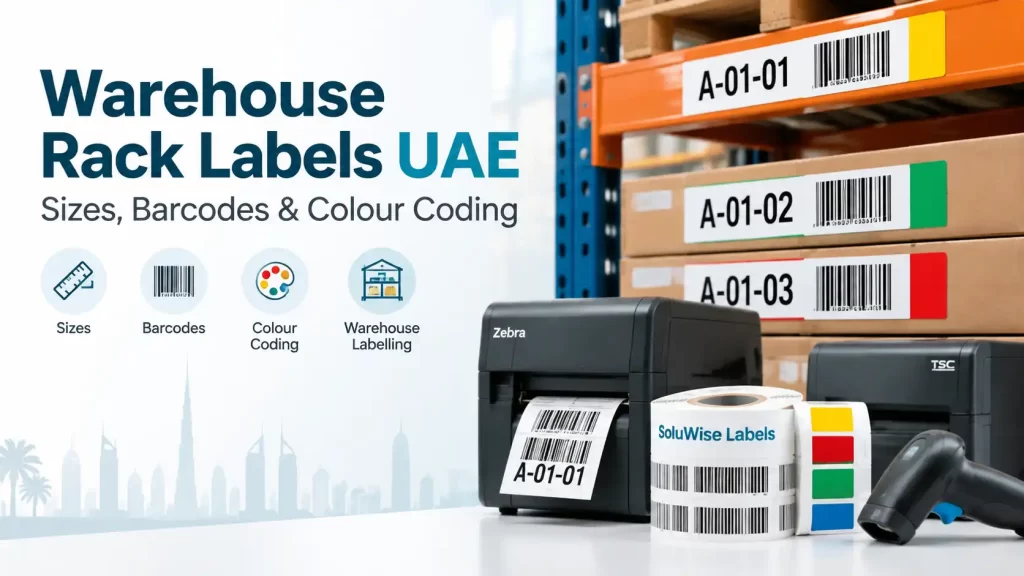
Warehouse teams depend on locations that can be found, scanned and understood quickly. A missing rack label, faded barcode or unclear bin ID can create picking errors that affect dispatch, inventory counts and customer service.
The right approach combines a logical location code with labels that suit the rack, viewing distance, scanner and working environment. For most UAE distribution centres, the practical starting point is a durable barcode label at every scannable location, supported by large aisle or bay identification where operators need to scan from a distance.
Why warehouse rack labels matter
Warehouse rack labels turn physical storage into a controlled location system. Instead of relying on an operator’s memory or a handwritten description such as “back row near receiving”, a warehouse management system can direct staff to a precise location such as A03-05-02-B.
That code can describe an aisle, bay, level and position. When the printed ID and barcode match the system record, receiving, put-away, replenishment, cycle counting and picking become easier to verify. The label does not prevent every error by itself, but it gives the operator a clear checkpoint before stock is moved or confirmed.
In busy Dubai and Abu Dhabi warehouses, labels are often exposed to forklift contact, dust, carton abrasion, heat and varying lighting. A low-cost paper label may be suitable for short-term carton identification, but it can be a poor choice for a rack location expected to remain in service for years.
Warehouse rack labels UAE: start with the location design
Before choosing label dimensions or a warehouse rack label printer, define a location structure that staff can read consistently. The code should be short enough to communicate verbally, yet detailed enough to identify one physical storage point without ambiguity.
A practical location-code example
A distribution centre might use R02-B14-L03-P02:
- R02 = rack or aisle 02
- B14 = bay 14
- L03 = level 03
- P02 = pallet position 02
The exact format can vary. A small parts store may need zone, shelving unit, shelf and bin. A high-bay pallet warehouse may use aisle, bay, beam level and left/right position. What matters is that the structure is documented, reflected in the warehouse software and applied consistently on every sign and label.
Avoid codes that can be confused at a glance. For example, organisations may choose to avoid using letters such as O, I and S where they could be mistaken for 0, 1 and 5. The same convention should be used in printed labels, handheld scanner screens and staff training materials.
Choose label size by viewing distance and scan method
Label size is not simply an aesthetic decision. It affects how quickly an operator can locate the ID, how easily a scanner can read the barcode and how much human-readable information can be printed without becoming cramped.
| Application | Typical label approach | What to prioritise |
|---|---|---|
| Small pick bins | Compact bin barcode labels on the bin front | Clear text, a simple barcode and enough quiet space around the symbol |
| Standard pallet rack locations | Medium-sized adhesive or magnetic rack labels at eye or scan height | Readable location code, durable face material and consistent placement |
| High-bay racking | Large rack markers or retroreflective labels | Long-range visibility, lighting performance and compatibility with scanning workflow |
| Temporary or changing storage | Magnetic rack labels or hanging labels | Easy relocation without leaving adhesive residue |
For shelf barcode labels and bin labels, the barcode should be large enough for the scanner and working distance used. A handheld scanner close to a picking bin can read a smaller symbol than an operator scanning a pallet location from a forklift. Do not reduce the barcode merely to make room for more text.
Leave clear blank space around the barcode, known as quiet zones. Keep the symbol away from label edges, folds, rivets, rack uprights and heavily scratched areas. A correctly designed barcode can still fail if it is placed where a fork tine, shrink wrap or rack protector repeatedly damages it.
Barcode formats: use the simplest format that fits the workflow
Most internal warehouse locations work well with a one-dimensional barcode such as Code 128 because it can encode letters, numbers and separators efficiently. It is commonly suited to location IDs such as R02-B14-L03-P02 and can be read by many barcode scanners.
A 2D barcode, such as a QR code or Data Matrix symbol, may be useful where the label needs to carry more data than a location reference. For example, a maintenance team may use a 2D code that links an asset identifier to inspection information in its own system. However, more data does not automatically create a better warehouse label. If staff only need to confirm a location, a simple, readable barcode is often easier to manage.
Barcode printing should be kept separate from barcode registration. Printing a location barcode creates a machine-readable representation of an internal code; it does not make that number GS1-issued, registered or certified. GS1 identifiers are generally relevant to traded products and supply-chain identification, while rack and bin IDs are usually controlled within the warehouse system.
Compare adhesive, magnetic, retroreflective and hanging labels
The label construction should reflect how permanent the location is and what will happen around it during normal work.
Adhesive warehouse rack labels
Adhesive warehouse rack labels suit fixed rack locations, shelving and bin fronts with clean, stable surfaces. They are a sensible choice where a label should remain in the same position for a long period. Material selection matters: a warehouse exposed to dust, friction and cleaning may require a more durable construction than a short-life paper label.
Adhesive labels are less suitable for surfaces that are oily, heavily textured, damaged or regularly changed. Surface preparation is often overlooked. Dust and residue can reduce adhesion long before the label material itself reaches the end of its useful life.
Magnetic rack labels
Magnetic rack labels are useful for operations that frequently reconfigure storage locations. They can be moved between steel rack beams or shelving without adhesive residue, making them practical for seasonal layouts, overflow areas and changing pick faces.
They are not a universal substitute for adhesive labels. Magnets need a suitable ferrous surface, can be displaced by impacts and may not be appropriate where the label must resist constant handling or where the rack design offers little flat contact area.
Retroreflective labels for high-bay operations
Retroreflective labels are designed for applications where scanning and visibility at distance matter, particularly in high-bay warehouse arrangements. Their reflective surface can help a scanner locate the label under suitable lighting conditions and from a greater distance than a small ordinary label.
They need careful placement and testing in the actual aisle. Racking shadows, warehouse lighting, scanner capability, angle of approach and forklift movement all affect real-world reading performance. A sample trial on a representative aisle is more useful than choosing purely from a label photograph.
Hanging labels
Hanging labels can suit wire cages, textile storage, awkward containers or locations with no reliable flat mounting surface. They are visible and can be replaced quickly, but they may swing, snag or become obscured if placed in active forklift routes. Use them where their movement will not interfere with scanning or safe access.
Colour coding should support readable location IDs
Colour coding can speed visual orientation. A warehouse may assign a different colour to each temperature zone, product family, aisle group, picking method or hazard category. For example, blue labels may identify ambient pick faces while yellow labels identify replenishment locations.
Colour must remain a secondary cue, not the only method of identification. Staff should still be able to read the location code and scan the barcode in normal lighting. Colour-only systems can cause mistakes for new team members, colour-vision differences, dirty labels and monochrome photocopies of operating documents.
Use high contrast between text and background. Dark text on a light background is often easier to read than pale text on a saturated colour. If coloured label stock is used, test barcode contrast with the intended handheld barcode scanners before approving a full rollout.
Printing options for warehouse labels
Industrial barcode printers are appropriate where a site prints rack labels, replenishment labels or bin labels regularly and needs control over format changes. Thermal transfer printing is often considered for durable warehouse labels because it uses a ribbon to create the image. The ribbon and label material need to be compatible with each other and with the expected exposure to rubbing, dust and handling.
Zebra and TSC are brands commonly considered for barcode printing applications. Rather than choosing by brand name alone, purchasers should compare the label width required, expected print volume, available print resolution, media handling and how the printer will connect to the warehouse workflow. A printer suited to small desktop labels may not be the right fit for frequent wide rack markers, while an industrial unit may be unnecessary for occasional low-volume printing.
Handheld barcode scanners should also be tested against the actual label size, barcode type and scanning distance. A scanner used by a picker at arm’s length has a different job from one used on a forklift in a high-bay aisle.
Placement rules that reduce scanning errors
- Use a consistent position. Put labels in the same relative place on every bay, shelf or bin so operators know where to look.
- Keep labels within the normal line of sight. Avoid placing primary scan labels behind pallet overhang, safety mesh or stretch wrap.
- Separate location and product labels. A bin may hold a product label and a location label; make the distinction obvious through position, heading or colour band.
- Plan for damage. Place labels away from known impact zones, or use protected mounting positions where possible.
- Test from the working position. Scan labels while standing, from the truck cab or at the actual picking height, not only at a desk.
A rollout workflow for UAE warehouses
Start with a short survey of the facility. Record rack types, beam surfaces, bin materials, lighting, aisle widths, picking methods, temperature conditions and areas exposed to dust or direct loading activity. This prevents a single label design being applied to locations with very different demands.
Next, finalise the location master data before printing. Check that every code is unique, that inactive locations are removed and that warehouse software uses the same format that will appear on the label. It is much easier to correct an ID in a spreadsheet than to replace hundreds of labels after installation.
Run a pilot in one representative zone. Print sample warehouse labels, apply them using the proposed method and ask actual users to scan them through a normal shift. Review scan failures, label damage, readability at distance and any confusion between rack and product identification.
After approval, install labels in logical sequence and retain a simple map of completed zones. Train staff on the meaning of the code, the purpose of colour bands and the procedure for reporting damaged labels. A routine inspection during cycle counts can identify labels that need replacement before they cause a transaction error.
Common mistakes to avoid
- Using one small label size for both close-range bins and high-level pallet locations.
- Printing location information in a font too small to read without a scanner.
- Applying adhesive labels to dusty or uneven rack surfaces without preparation.
- Using colour as the sole identifier instead of printing a readable code.
- Changing warehouse location codes without updating the software and physical labels together.
- Assuming a barcode that scans at a desk will scan from a forklift or under warehouse lighting.
- Selecting a warehouse rack label printer without checking media width, expected print volume and label material compatibility.
Frequently asked questions
What size should warehouse rack labels be?
Size depends on viewing distance, barcode type and the amount of human-readable text required. Small bin locations can use compact labels, while pallet racks and high-bay locations usually need larger text and barcode symbols. Test samples at the real scan distance before ordering a full batch.
Are magnetic rack labels better than adhesive labels?
Neither is automatically better. Magnetic labels suit steel racking that changes regularly, while adhesive labels suit stable, long-term locations with suitable clean surfaces. The choice depends on how often the storage layout changes and how much physical contact the label receives.
Which barcode format is suitable for bin barcode labels?
Code 128 is often suitable for internal bin and rack IDs because it can encode letters and numbers efficiently. A 2D code may be useful if the workflow needs more data, but it should be selected only if the scanner and software support it and the added information has a clear purpose.
Can colour coding replace barcode scanning?
No. Colour can help staff recognise a zone or process, but it cannot provide the accuracy of a unique printed location ID and barcode. Use colour as a visual aid alongside readable text and a scannable symbol.
What labels work in dusty warehouse conditions?
For fixed locations, a durable label construction selected for abrasion and handling is generally more appropriate than a short-life paper label. The rack surface should be cleaned before application, and labels should be positioned away from direct impact where practical. A site trial is useful for confirming performance.
Do high-bay warehouses need retroreflective labels?
Not always. Retroreflective labels can be useful where labels must be identified or scanned at distance, but their suitability depends on the scanner, lighting, rack geometry and operating method. Test a sample in the actual aisle before standardising on this approach.
A well-planned warehouse identification project begins with clean location data and ends with a practical field test. Match label construction to the rack environment, keep IDs readable, use colour carefully and test every barcode from the position where staff will actually scan it.


