
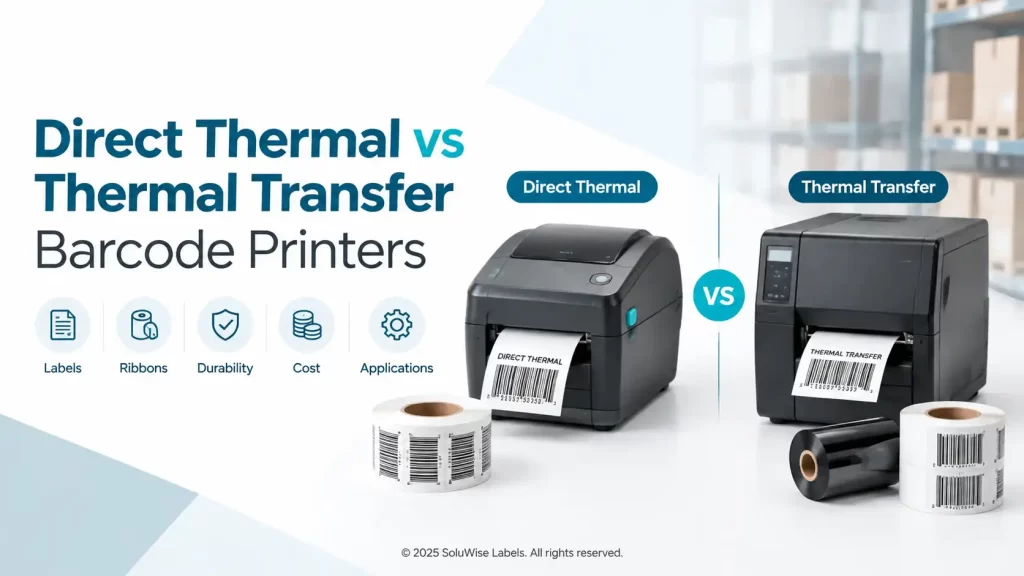
Selecting a barcode printer in the UAE often means balancing upfront cost, label durability, and the conditions under which your labels will be read. Direct thermal and thermal transfer printing use different mechanisms and consumables, which can impact label performance in Dubai warehouses, shops, and manufacturing floors. This guide explains the core differences, helps you choose based on your environment and workload, and shows how SoluWise’s Zebra lineup can support your UAE operation.
Direct answer / overview
Direct thermal printers produce labels without a ribbon by using heat-sensitive label stock. They are generally lower in upfront cost and well suited to short-term labeling that stays indoors or in controlled environments. Thermal transfer printers use a ribbon to transfer ink onto the label, resulting in more durable labels that resist heat, moisture, and abrasion—ideal for outdoor, cold-chain, or long-lasting identifiers. Your choice depends on label life, environmental exposure, and total cost of ownership over time.
Key factors to consider
1) Environment and label life
In the UAE, many operations face heat, humidity, and varying storage conditions. Direct thermal labels are attractive for low-cost, short-term use (receipts, shipping notices, indoor asset tags that won’t endure long-term exposure). If labels will be exposed to sun, heat, or moisture, or need to last months or years, thermal transfer labels with a suitable ribbon are typically the better option. Synthetic label stock paired with thermal transfer printing often delivers the longest readability under challenging conditions.
2) Ribbon vs. no-ribbon model
Direct thermal printing does not require a ribbon. This keeps purchase costs down and simplifies consumables. Thermal transfer printing relies on a ribbon (wax, wax-resin, or resin formulations) chosen to match the label stock and environmental conditions. Ribbons add ongoing cost but significantly extend label life, making them worthwhile for outdoor, industrial, or outdoor-use labels, as well as critical identifiers in warehouses and production floors.
3) Label materials and durability
Label stock comes in various materials, finishes and adhesives. For direct thermal, you’ll usually use standard heat-sensitive paper labels. For thermal transfer, you’ll pair your label stock with a ribbon and can select wax, wax-resin, or resin ribbons to achieve the required durability. In the UAE, choosing the right stock for heat, humidity and potential abrasion is essential for maintaining readability and legibility over time.
4) Cost of ownership
Direct thermal printers generally have lower upfront costs and simpler maintenance. If your labeling is short-term and confined to indoor use, this can be cost-effective. Thermal transfer printers incur ongoing ribbon costs and sometimes higher initial printer costs, but the labels last longer and resist environmental challenges, which can reduce re-labeling frequency and improve logistics accuracy in warehouses and manufacturing settings.
5) Print quality and resolution
Most desktop printers in this category offer common resolutions (often 203 dpi or higher). Higher resolution is beneficial for small or dense barcodes and small fonts on minimal label space. If you routinely print tiny barcodes or need sharp text on durable labels, ensure the printer supports your desired resolution and that you match the print mode with the label stock.
6) Connectivity and workflow
In UAE operations, reliable network connectivity and easy integration with ERP or WMS systems are important. Look for printers with USB and Ethernet at a minimum, and consider models offering Wi-Fi or cloud-enabled management if your site needs flexible deployment. Software compatibility and driver support can influence setup time and ongoing maintenance.
Detailed comparison
Below is a concise, practical comparison to help you weigh factors quickly. The table reflects typical considerations rather than model-specific specs.
| Factor | Direct Thermal | Thermal Transfer |
|---|---|---|
| Printing method | Heat-sensitive label stock; no ribbon | Ribbon transfers ink onto label stock |
| Durability of labels | Moderate; susceptible to heat, light and abrasion | High; suitable for harsh environments and long-term use |
| Consumables cost | Lower upfront; ribbons not required | Ribbon cost adds to operating expenses |
| Best use | Short-term labels, indoor environments | Long-term, durable labels, outdoor or harsh environments |
| Label material options | Standard paper labels | Wide range including synthetic stocks |
Which option is right for you?
Consider your typical workflow, label life requirements, and environment. The following scenarios are common in UAE operations:
- Small business or retail with indoor labeling needs: Direct thermal printers can be a cost-effective solution for shelf labels, receipts, and short-term shipping labels where environmental exposure is limited and durability needs are modest.
- Warehousing, logistics, or manufacturing with longer label life needs: Thermal transfer printing delivers longer-lasting identifiers that withstand heat, humidity and abrasion—useful for asset tagging, serialized items, and outdoor-related applications.
- High-volume, continuous printing: When label longevity matters and you print thousands of labels per day, thermal transfer with appropriate ribbons and label stock helps reduce reprint costs and downtime.
- Hybrid environments: Some operations use direct thermal for short-term labels and reserve thermal transfer for assets and outdoor use. If you need flexibility, choose a printer that supports the appropriate mode or plan for dedicated devices per use case.
Recommended SoluWise products
SoluWise carries a curated selection of Zebra printers that cover entry-level to higher-demand workflows. The models listed here represent common choices for UAE businesses and can be paired with our range of barcode labels and ribbons to match your use case.
- Zebra ZD220 — a compact desktop printer suitable for small offices or retail counters. It provides a reliable, easy-to-manage solution for basic labeling tasks and short-term needs in indoor environments.
- Zebra ZD421 — a versatile mid-range printer designed for moderate workloads. It is well-suited to small-to-medium warehouses or retail operations that require consistent performance and flexible media support.
- Zebra ZD621 — a robust option for higher-volume or more demanding environments, including manufacturing floors or larger warehouses. It is positioned to handle longer runs with dependable print quality.
All three models are part of SoluWise’s Zebra lineup and pair well with our UAE-suitable label stocks and ribbons. If you need help choosing the right model for your label size, lifetime exposure, and print volume, SoluWise can guide you to the right combination.
Common mistakes to avoid
- Underestimating label life: Use direct thermal for short-term needs, but don’t rely on it for environments that cause fading or abrasion.
- Skipping ribbon analysis: If you select thermal transfer, choose the ribbon type (wax, wax-resin, resin) to match your film or paper labels and environmental conditions.
- Ignoring label compatibility: Ensure label stock, adhesive, and thickness suit your printer and your application, especially in heat and humidity.
- Overlooking maintenance: Regular cleaning and printhead care extend printer life and print quality in busy UAE environments.
Frequently Asked Questions
- What is the main difference between direct thermal and thermal transfer printers?
- Direct thermal printers use heat-sensitive labels with no ribbon, offering low upfront costs but shorter label life. Thermal transfer printers require a ribbon and produce durable labels suitable for longer-term use and harsher environments.
- Do I need ribbons for direct thermal labeling?
- No. Direct thermal labeling does not require ribbons, which keeps consumables simple and inexpensive for short-term needs.
- Can direct thermal labels be used outdoors in the UAE?
- Direct thermal labels degrade more quickly when exposed to heat and sunlight. For outdoor or harsh conditions, thermal transfer with an appropriate ribbon is usually preferred.
- Which printer is cheaper to operate in the long term?
- Direct thermal often has lower upfront costs, but thermal transfer can lower total cost of ownership by reducing re-labeling due to longer label life, especially in demanding environments.
- Can SoluWise help me choose a printer for my UAE business?
- Yes. Our team can assess your label size, print volume, and operating environment to recommend the right Zebra model and compatible media and ribbons.
- Which Zebra models are commonly used in UAE warehouses?
- Models such as the ZD220, ZD421 and ZD621 are frequently chosen for their balance of cost, performance and flexibility across indoor and semi-industrial settings.
Final recommendation
For UAE businesses starting with light to moderate labeling demands and indoor environments, a direct thermal approach with a compact printer like the ZD220 can be a practical and affordable option. If you anticipate longer label life requirements, outdoor exposure, or higher print volumes, consider a more versatile Zebra model such as the ZD421 or ZD621 and pair it with appropriate label stock and ribbons. In any case, align the printer choice with your label size, required durability, and anticipated print volume to minimize reprints and downtime.
If you’re unsure which label material, printer or ribbon is suitable for your application, SoluWise can help you select the right combination based on your label size, printing volume and operating environment. Reach out to discuss your UAE use case and we’ll map a practical solution that fits your budget and workflow.


