
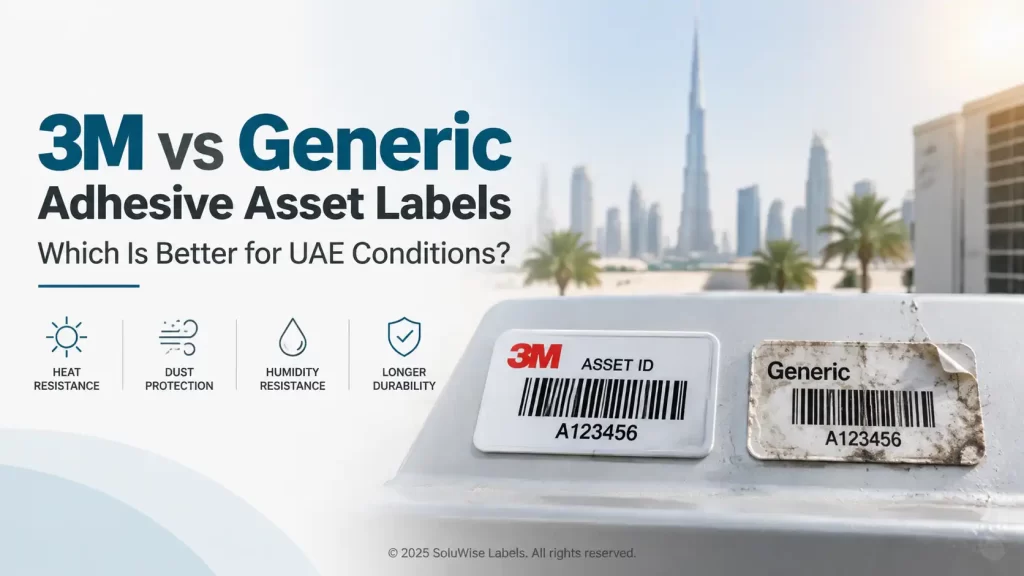
A label that stays on a laptop in an air-conditioned office may fail quickly on an outdoor pump, warehouse trolley or rooftop control panel. In the UAE, heat, humidity, dust, cleaning chemicals and direct sun can all affect how well an adhesive holds.
For businesses comparing 3M asset labels vs generic labels, the practical answer is this: a properly specified 3M-based construction is often the safer choice for difficult surfaces, outdoor exposure and assets that need to remain identifiable for years. A good generic label can still be the sensible purchase for indoor, lower-risk assets where replacement is easy and the surface is clean and smooth.
The brand name on its own is not the full answer. Adhesive type, face material, laminate, surface condition and application method matter just as much. A premium adhesive label applied to a dusty, oily panel can fail; a suitable generic label on a clean office monitor may perform perfectly well.
3M asset labels vs generic labels: the main difference
3M asset labels generally refer to labels made with 3M adhesive materials or specified adhesive systems. They are commonly selected where the bond needs to cope with demanding conditions, irregular surfaces or longer service periods. However, not every 3M-based label is intended for the same application, so the chosen construction still needs to match the asset and environment.
Generic adhesive asset tags are not one fixed product type. They can range from economical paper labels for basic identification to synthetic labels with adhesives suitable for more demanding use. That variation is why a simple price comparison can be misleading. One generic label may be entirely adequate, while another may lift at the corners after a few weeks on a hot metal cabinet.
| Factor | 3M-based adhesive asset labels | Generic adhesive asset labels |
|---|---|---|
| Typical fit | Long-term, high-exposure or difficult applications | Indoor assets, controlled environments and lower replacement-risk use |
| Adhesive consistency | Often chosen where a specified adhesive performance is required | Depends heavily on the supplier and label construction |
| Initial cost | Usually higher | Usually lower, particularly for standard labels |
| Outdoor equipment | Often the more suitable starting point, subject to material selection | May suit only where exposure is limited and replacement is acceptable |
| Value over time | Can make sense where relabelling, asset confusion or downtime is costly | Can offer good value for stable, easy-to-relabel indoor assets |
Heat and humidity in UAE workplaces
Dubai and other UAE locations create a particular challenge for adhesive asset tags because surface temperatures can become much higher than the surrounding air, especially on equipment exposed to sun. Heat can soften some adhesive systems, while repeated expansion and contraction of metal, plastic or painted surfaces can gradually work at the label edges.
Humidity adds another issue. It may not be obvious on a dry-looking asset, but condensation, wash-down routines, outdoor storage and coastal conditions can affect adhesion over time. Labels on chilled equipment can also face temperature changes that are very different from those on a standard warehouse shelf.
What heat does to a label bond
Adhesive needs close contact with the asset surface. High heat can make a label more likely to shift before it has settled, particularly if it is applied to a warm panel or pressed over dust and texture. It can also expose weak adhesive choices on low-surface-energy plastics, powder-coated metal and painted equipment.
For outdoor plant, generators, tools, delivery equipment or equipment stored near loading bays, a more durable construction is usually a better use of budget than the lowest-cost sticker. This is where 3M asset labels may justify their higher upfront cost, provided the material and adhesive have been selected for that surface.
Humidity, cleaning and handling
Hotel, healthcare, facilities and food-service environments often involve frequent cleaning. A label that only needs to withstand occasional dry wiping is different from one exposed to moisture, detergents or repeated handling. The printed information must also remain readable; a label that remains attached but loses its asset number is still a failed identification label.
Ask for a label sample and test it on the actual asset where possible. Apply it to a clean representative surface, allow it to settle, then inspect it after normal cleaning, handling and temperature exposure. A short site trial is more useful than choosing by price alone.
Long-term hold on outdoor equipment
Outdoor equipment is where generic labels most often become a false economy. That does not mean every generic option will fail, but the risk rises where the asset is exposed to sun, dust, rain, moisture, abrasion or frequent contact.
A label on the inside of an electrical enclosure has a much easier job than one on its exterior door. Likewise, an asset tag on an office chair is not comparable to one on a forklift, rooftop unit or mobile maintenance trolley. The expected service life should drive the label choice.
- Outdoor fixed assets: Use a construction intended for long-term adhesion and readable identification in exposed conditions. Consider metal asset tags where the equipment is particularly valuable, permanently installed or subject to heavy abrasion.
- Warehouse assets: Synthetic adhesive labels may suit racks, bins, scanners, carts and equipment, but the adhesive should match painted steel, plastic or rough surfaces.
- IT and office assets: Standard asset labels can be cost-effective for laptops, monitors, printers and furniture in climate-controlled areas, provided the surface is clean and smooth.
- Tools and mobile equipment: Select labels based on grip points, oils, impacts and cleaning. A label placed on a frequently handled curved handle will face more stress than one on a flat protected panel.
Where SoluWise asset labels fit
SoluWise asset labels suit businesses that need clear, organised identification for equipment, IT assets, stockroom items and operational tools. The useful starting point is not “Which label is cheapest?” but “What does this label need to survive?” A label for an indoor desktop printer is a different requirement from one for an outdoor compressor.
For standard indoor asset control, a suitable adhesive label can provide a practical balance of identification quality and cost. It is a sensible option for organisations with many assets that are kept in offices, stores, hotels or controlled warehouse areas. The limit is exposure: standard adhesive labels should not be assumed to perform like an outdoor-rated construction simply because both carry an asset number.
Metal asset tags are better suited to equipment where an adhesive label may be exposed to severe abrasion, heat, rough handling or a very long ownership period. They are not automatically necessary for every asset. For a high volume of ordinary office equipment, metal can add cost without adding much practical benefit. For fixed machinery, external equipment or assets with a long replacement cycle, it can be a sensible option to assess.
Businesses choosing between adhesive and metal identification should also review how to choose asset label adhesive for different surfaces. Surface material is often the deciding factor, especially with textured plastics, powder-coated metal, oily equipment and uneven finishes.
Cost difference: price per label versus cost of failure
Generic labels usually have the advantage on purchase price. That matters when labelling hundreds or thousands of lower-value indoor assets. If a label can be replaced quickly, the financial case for a premium adhesive is weaker.
The calculation changes when a missing label causes extra work. A faded or detached tag can slow an annual asset count, create confusion during maintenance, make ownership harder to confirm or lead to repeated relabelling. On a large outdoor asset, the labour involved in accessing and relabelling it may cost more than the difference between a standard label and a higher-grade one.
Rather than applying one label type to every item, many UAE businesses benefit from dividing assets into groups:
- Indoor, low-risk assets that can use a cost-conscious standard adhesive label.
- Frequently handled or operational assets that need a tougher label construction.
- Outdoor, high-value or long-life equipment that may need a premium adhesive system or a metal asset tag.
This approach controls spend without treating a rooftop unit and an office keyboard as the same labelling job.
Checks before ordering adhesive asset tags
Identify the actual surface
“Metal equipment” is not enough detail. Is it bare metal, painted metal, powder coating, textured plastic, rubberised plastic or a curved casing? Adhesives react differently to each. If the equipment has been treated with oil, silicone cleaner or polish, cleaning and preparation become even more important.
Decide where the label will sit
Place the label on a flat, accessible area where it can be scanned or read without repeated rubbing. Avoid corners, deep texture, joints, vents, areas that become extremely hot and locations regularly struck by tools or cables.
Prepare the surface properly
Applying labels over dust, oil or moisture is one of the most common avoidable mistakes. Clean the application area using a suitable method for the surface, let it dry fully and press the label down firmly, including its edges. Avoid moving or testing the label immediately after application if it has not had time to settle.
Check the print and the information
Choose an asset number format that staff can read and record easily. If the label includes a barcode, test it with the scanner used on site and allow enough contrast and quiet space around the code. Printing a barcode is separate from any barcode numbering or registration system; for internal asset control, the key requirement is that the chosen code works reliably with the organisation’s own records.
FAQ
Are 3M asset labels better than generic labels?
They are often the better choice for demanding surfaces, outdoor exposure and longer service expectations. For clean indoor equipment where labels are easy to replace, a suitable generic label may be more economical.
Will adhesive labels survive UAE summer heat?
Some can, but performance depends on the adhesive, face material, surface and direct sun exposure. Treat outdoor and heat-exposed equipment as a separate application from indoor office assets.
Can generic labels be used on outdoor equipment?
They can be used if the particular label construction is appropriate for the expected conditions. A low-cost indoor label should not be selected for exterior equipment just because it sticks initially.
When should a business choose metal asset tags?
Metal asset tags are worth considering for fixed machinery, high-value equipment, long-life assets and locations where abrasion or weather makes adhesive labels less suitable. They may be unnecessary for ordinary office inventory.
Why do asset labels peel from equipment?
Common causes include dust, oil, moisture, textured or low-energy surfaces, heat, edge lifting and an adhesive not suited to the material. Application technique can be as important as the label itself.
Should every asset use the same label material?
Usually no. A tiered approach is more practical: standard labels for protected indoor items, tougher adhesive labels for operational equipment, and metal tags where the environment or asset value calls for them.
Choose for the asset, not the label price
For 3M asset labels vs generic labels, the deciding rule is straightforward: use the label that matches the surface, exposure and cost of replacement. Generic labels are often perfectly sensible for indoor asset control. For equipment exposed to UAE heat, humidity, sunlight or rough handling, a specified premium adhesive construction or metal asset tag is normally the more defensible choice.
If the surface, location or expected label life is unclear, SoluWise can review the application details and suggest a practical label option before a full order is placed.


