
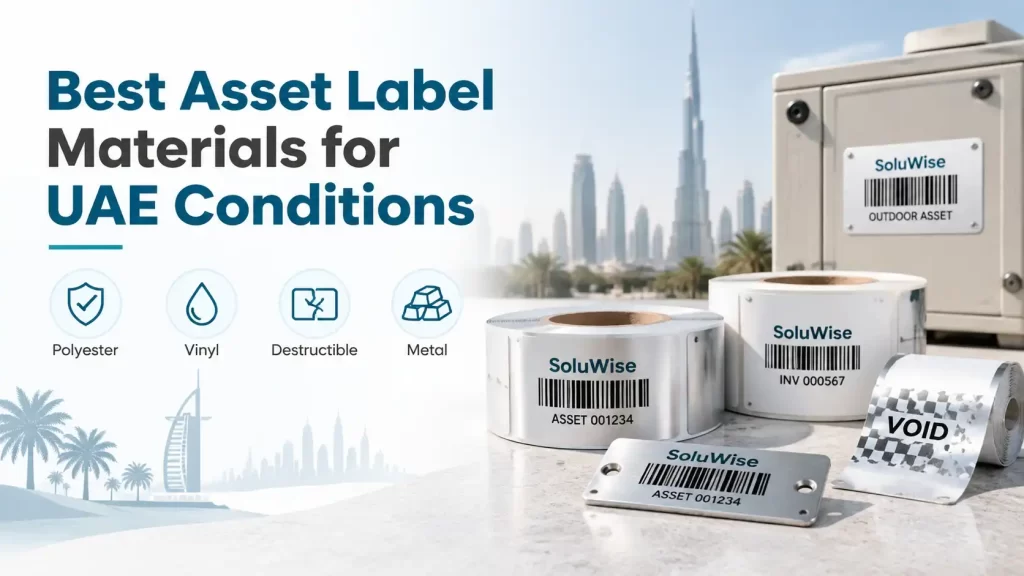
Selecting asset label materials in the UAE is mainly an environmental decision. A label that performs well in an air-conditioned office may fail quickly on equipment stored in a hot warehouse, exposed to sunlight, cleaned regularly or moved between humid outdoor and indoor areas.
For most fixed assets, polyester is the practical starting point because it offers a good balance of print quality, adhesive performance and resistance to handling. Vinyl is more useful on curved or uneven surfaces, destructible materials help indicate tampering, and metal asset tags suit assets facing severe wear, heat or long service life.
The right choice depends on the asset surface, expected exposure, cleaning routine, barcode scanning requirements and whether the label must show evidence of removal. A low-cost label that needs frequent replacement often costs more in labour and lost asset records than a material chosen properly from the outset.
Choosing asset label materials UAE businesses can rely on
Asset labels are used to identify IT equipment, warehouse machinery, tools, furniture, medical devices, hospitality equipment and many other business assets. The printed number or barcode is only useful if it remains attached and readable throughout the asset’s working life.
In Dubai, Abu Dhabi and other parts of the UAE, common risks include high ambient temperatures, UV exposure near loading bays or outdoor sites, dust, humidity, abrasion from handling and cleaning chemicals. These conditions do not affect every asset equally. A desktop monitor in an office, for example, has very different requirements from a generator, pallet truck or field tool.
For commercial investigation, the most useful approach is to assess the working environment first and then choose a material. Material selection should come before deciding on label size, numbering format or artwork.
Material comparison: polyester, vinyl, destructible and metal
| Material | Best suited to | Main strengths | Potential limitations |
|---|---|---|---|
| Polyester | IT assets, office equipment, warehouse equipment, indoor machinery | Good print definition, abrasion resistance and long-term identification performance | Less suitable than flexible vinyl for highly curved, textured or irregular surfaces |
| Vinyl | Curved containers, cables, bins, uneven equipment housings and awkward surfaces | Flexible material that can conform better to non-flat surfaces | May not be the preferred option where maximum scratch resistance is the main requirement |
| Destructible | Portable electronics, leased equipment, controlled tools and tamper-sensitive assets | Breaks apart when removal is attempted, making transfer more difficult | Not intended for assets that need labels removed cleanly during refurbishment or reassignment |
| Metal | Industrial plant, outdoor equipment, heavy tools and long-life fixed assets | High physical durability and a permanent-looking identification method | Usually needs mechanical fixing or a suitable attachment method; less flexible than label stock |
Polyester asset labels: the all-round choice for many assets
Polyester 3M asset labels are commonly selected for laptops, desktop computers, monitors, printers, network hardware, office furniture, shelving and indoor industrial equipment. Their firm face stock supports crisp text, asset numbers and barcodes, which matters where staff scan items during audits.
For many organisations, polyester is the sensible default for durable asset labels in Dubai because it can handle regular contact, light abrasion and typical workplace cleaning better than paper-based labels. It is particularly useful where the label needs to remain professional and legible over several years.
Adhesive choice is as important as the polyester itself. Smooth painted metal, powder-coated cabinets, plastic housings and glass can all behave differently. A label applied to a dusty, oily or damp surface may lift at the corners regardless of the material selected.
Where polyester may not be enough
Polyester is not automatically the answer for every application. Equipment stored outdoors without shelter may need a more application-specific construction, especially where strong sunlight, heavy abrasion or frequent chemical contact is expected. It can also struggle to sit neatly on very tight curves, deep textures or rough cast surfaces.
Before a large rollout, apply samples to representative assets and inspect them after normal cleaning, handling and exposure. This is more informative than testing only on a clean sample panel in an office.
Vinyl asset labels for curved and uneven surfaces
Vinyl asset labels are valuable where flexibility matters. They can suit rounded bins, cable-management equipment, curved plastic cases, cylindrical containers and equipment with slight contours. A more conformable material is less likely to bridge across a curve and lift prematurely.
Vinyl is also worth considering where an asset has a textured or irregular surface, although adhesion should still be tested on the actual substrate. Deeply textured plastics, rough concrete, porous surfaces and heavily powder-coated finishes can require a specialised adhesive approach.
The trade-off is that flexible materials are not always the first choice for applications subject to constant scraping. If forklifts, tools, carts or protective cases repeatedly rub against the label, assess abrasion exposure before specifying vinyl simply because it is flexible.
Destructible asset labels for tamper evidence
Destructible asset labels are designed to fragment or break apart if someone tries to remove them. They are useful where an organisation wants a visible indication that an asset label has been interfered with or transferred to another item.
Tamper-evident asset labels can suit laptops, tablets, handheld scanners, audiovisual equipment, leased devices, calibrated tools and controlled equipment. They can also support internal asset-control procedures where a missing or damaged label prompts a check of the item’s record.
They should not be treated as a security system by themselves. A destructible label may discourage casual label swapping and reveal attempted removal, but it cannot prevent theft or replace physical access controls, serial-number records or periodic asset checks.
Plan for asset refurbishment and disposal
Destructible labels have a practical limitation: removal is intentionally difficult. If equipment is regularly refurbished, sold, redeployed or returned under a lease, the operations team should decide in advance how old identification will be managed. Applying a tamper-evident label to a surface that must later look pristine may be unsuitable.
Metal asset tags UAE industrial sites may prefer
Metal asset tags are intended for demanding applications where an ordinary adhesive label may not offer the desired service life. They can suit industrial machinery, outdoor plant, generators, pumps, fixed tools, construction equipment and long-life infrastructure assets.
The major advantage is physical resilience. Metal tags are less vulnerable to tearing and may remain identifiable where equipment faces repeated contact, harsh handling or extended outdoor exposure. Their attachment method deserves as much attention as the tag material: screws, rivets, wire fixing or other methods need to suit the equipment and maintenance rules.
Metal is not automatically necessary for every warehouse asset. It can add installation time and may be unsuitable for lightweight electronic housings, curved plastic equipment or surfaces where drilling is not permitted. For standard IT and office assets, polyester is often more practical.
Barcode readability depends on material, print method and placement
A barcode does not remain scannable simply because it was readable on the day it was printed. Fading, scratching, poor contrast, smudging and label lifting can all interrupt scanning. Material selection, print process and the barcode design need to work together.
For durable labels, thermal transfer printing is commonly considered because the ribbon-based process can produce a more durable image than methods intended for short-life labels. The ribbon, label face stock and adhesive should be selected as a combination rather than as separate purchasing decisions.
Keep barcode symbols large enough for the scanner and expected scanning distance. Avoid placing labels across seams, sharp curves, ventilation slots, screw heads or areas likely to be covered by protective cases. A barcode should be tested with the actual scanner used by the team, not only viewed on screen.
Barcode numbers and asset records are separate decisions
Printing a barcode on an asset label gives staff a machine-readable way to identify an item. It does not create a product registration, make an identifier GS1-issued or establish an asset-management record on its own. The barcode must be linked to an internal asset register, software system or documented numbering process to be useful.
Adhesive and surface compatibility checks
Even high-quality durable asset labels can fail if they are applied incorrectly. Surface preparation is often overlooked during bulk labelling projects, particularly when teams are working quickly through hundreds of assets.
- Identify the substrate: smooth metal, painted metal, polypropylene, ABS plastic, glass, rubber, textured plastic or another material.
- Check the surface condition. Dust, oil, condensation, polish and cleaning residue can reduce adhesive contact.
- Clean and dry the intended label area using a method appropriate for the asset and workplace procedure.
- Apply the label to a flat, accessible area and press it down firmly, especially around edges.
- Allow the adhesive to settle before subjecting the asset to cleaning, heat or heavy handling where practical.
- Test a small batch first, then inspect after realistic use.
Labels applied in very hot conditions deserve extra care. If the asset surface is hot from direct sun or equipment operation, application may be less predictable than in normal indoor conditions. It is sensible to label equipment when it is clean, dry and at a manageable temperature.
Application matrix for common UAE business assets
| Application | Typical exposure | Starting material to assess | Key check |
|---|---|---|---|
| Laptops, monitors and printers | Indoor handling, cleaning, occasional movement | Polyester asset labels | Plastic texture, cleaning routine and label placement |
| Warehouse bins and reusable containers | Handling, dust, curves and occasional outdoor movement | Vinyl or polyester | Curvature, rubbing points and adhesive grip |
| Handheld terminals and portable tools | Frequent handling and risk of label transfer | Destructible asset labels | Refurbishment needs and tamper-evidence requirement |
| Outdoor equipment and fixed machinery | UV, heat, abrasion and weather exposure | Metal asset tags | Fixing method, mounting location and access for scanning |
| Hotel back-of-house equipment | Cleaning products, movement and humidity | Polyester or destructible labels | Chemical exposure and whether asset transfer is a concern |
Common purchasing mistakes to avoid
- Choosing by price alone: a cheap label can create repeated relabelling work and unreliable audits.
- Ignoring the surface: label stock that performs on smooth metal may fail on low-surface-energy plastic or textured housings.
- Ordering before testing: a small sample trial can reveal lifting, fading or scanning issues before a full project begins.
- Using one material for every asset: a mixed estate of office IT, outdoor equipment and tools often needs more than one label type.
- Making barcodes too small: compact labels still need symbols that staff can scan reliably with their available equipment.
- Applying labels in poor locations: avoid high-wear edges, hand grips, hinges, vents and removable covers unless the application specifically requires them.
FAQ: asset label material selection
Which material is best for office IT assets?
Polyester is usually the first material to assess for laptops, monitors, printers and network equipment because it supports clear barcodes and holds up well under normal indoor handling. Test the adhesive on the specific plastic or painted surface before a large order.
Are vinyl asset labels suitable for outdoor use?
Vinyl can be useful for flexible applications, but outdoor suitability depends on the full label construction, adhesive, ink or ribbon, UV exposure and the expected service life. Outdoor assets should be tested in their actual operating environment.
Can destructible labels stop equipment theft?
No. They provide evidence that a label has been removed or disturbed, which can support asset-control procedures. They do not replace locks, access controls, serial-number records or physical security.
Why do asset label barcodes stop scanning?
Common causes include abrasion, fading, poor print contrast, a barcode that is too small, label lifting, unsuitable placement or contamination from dirt and cleaning products. Test both the printed label and scanner under normal working conditions.
Are metal asset tags necessary for warehouse equipment?
Not always. Polyester labels can be suitable for many indoor warehouse assets. Metal tags become more relevant where equipment receives heavy wear, remains outdoors, faces high heat or needs a long-life physical identifier.
Should every asset have the same label material?
Usually not. Businesses with both office equipment and industrial assets often benefit from using polyester for standard assets, tamper-evident labels for controlled portable equipment and metal tags for severe environments.
Make the selection from the actual working conditions
A useful asset-label specification starts with a short list of facts: the asset type, surface material, label dimensions, indoor or outdoor exposure, cleaning chemicals, expected label life, barcode size and scanning method. This gives purchasing teams a clearer basis for comparing options than choosing a material from appearance alone.
For many organisations, polyester asset labels are the practical default. Add vinyl where flexibility is needed, destructible labels where tamper indication matters, and metal tags where the physical environment is genuinely demanding.


