
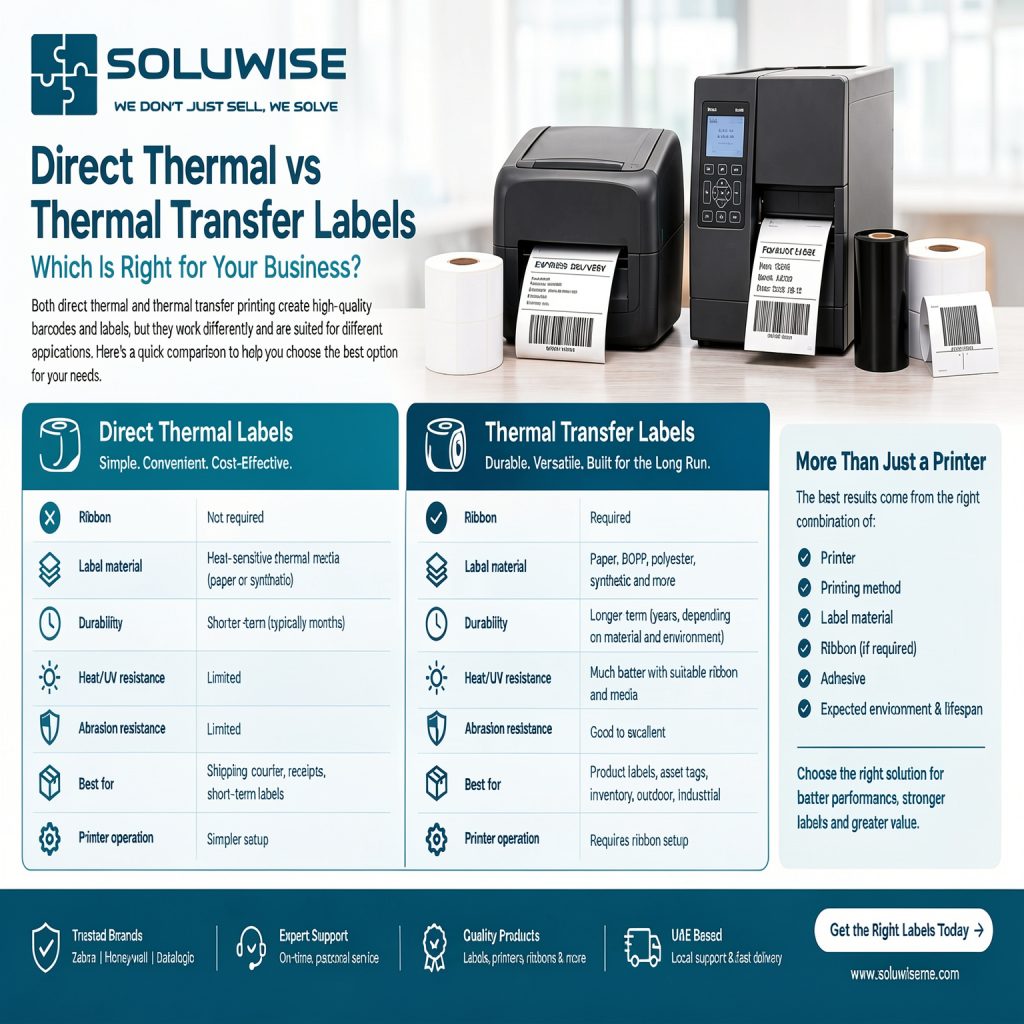
Choosing between direct thermal and thermal transfer labels is not just a matter of price. In the UAE, where label performance must withstand heat, humidity, sun exposure, and harsh environments, the wrong choice can lead to unreadable barcodes, costly reprinting, and operational delays. This guide helps UAE business owners, warehouse managers, retailers, and manufacturers understand the trade offs, what to look for when selecting labels, and practical recommendations for selecting a printer and consumables that align with your printing volume and environment.
In short, the question often reduces to direct thermal vs thermal transfer. Each technology serves different use cases, and a clear understanding of your application will save you time and money in the long run.
Direct answer / overview
Direct thermal labels are generally best for short term labeling that stays indoors and away from sunlight or high heat. They are simple, affordable, and require fewer consumables because there is no ribbon involved. Thermal transfer labels, on the other hand, use a ribbon to transfer ink onto a label surface. This delivers superior durability, resistance to heat, moisture, chemicals, and UV light, making them well suited for harsh environments such as warehouses, outdoor locations, and equipment labeling that must endure long service lives.
For many UAE businesses, the quick decision is whether you need low upfront cost and short term reads (direct thermal) or long term durability and outdoor capability (thermal transfer). Your label material, printer capabilities, and the expected life of the label determine the best fit.
Key factors to consider
1) Environment and durability
Direct thermal labels are sensitive to heat, sunlight, and moisture. In Dubai and other hot or humid regions, direct thermal prints can fade or darken over time, especially when exposed to bright light and outdoor conditions. If labels will be applied to assets or packages that travel through sunlit loading docks or hot storage, consider thermal transfer with a synthetic stock for durability.
Thermal transfer labels use a ribbon to bond ink to the label surface. The result is a more durable print that resists fading, abrasion, and common chemicals. If your labels are exposed to rain, humidity, wash downs, or outdoor lighting, thermal transfer is the safer long term choice.
2) Cost considerations
Direct thermal printing has lower upfront costs. There is no ribbon to buy and the label stock tends to be cheaper. For very small operations or short term labeling, this can be a solid cost saver.
Thermal transfer carries higher initial costs due to ribbons and sometimes more robust printers. However, per label the cost can be competitive, especially when you factor in label longevity and the reduced need for reprints. In the UAE, where replacing damaged labels quickly can prevent downtime, the longer term cost can justify the investment in thermal transfer for durable applications.
3) Printer and consumable ecosystem
Direct thermal printers are simpler to operate with fewer moving parts. They are ideal for low to medium print volumes. Thermal transfer printers support ribbons and a wider range of label stocks including synthetic materials such as polypropylene, polyethylene, and polyester. When selecting a printer, consider the availability of ribbons, stock compatibility, and service support in the UAE to minimize downtime.
4) Label stock and application
Direct thermal labels are commonly available in standard materials used for indoor short term labeling. For example, price tags, pick faces, and some indoor asset labels. Thermal transfer labels open up a broader material palette, including waterproof or chemical resistant stocks, which is advantageous for asset management, warehouse labeling, and manufacturing environments common in the UAE.
5) Print volume and maintenance
High volume operations often justify the extra cost of ribbons and longer lasting label stock. Ribbon consumption depends on print quality settings and the type of stock used. Regular maintenance, including printhead care and proper ribbon tension, is essential to maintain readability in high duty cycles.
Detailed comparison / explanation
| Aspect | Direct Thermal | Thermal Transfer |
|---|---|---|
| Printing method | Direct contact heat on heat-sensitive label stock; no ribbon required | Uses a printer ribbon to transfer ink to label stock |
| Durability | Less durable; fades with heat, light, and moisture | Highly durable; resistant to UV, moisture, chemicals, and abrasion |
| Best for | Short term indoor labeling, retail price tags, receipts | Long term indoor or outdoor labeling, asset tracking, harsh environments |
| Running costs | Lower upfront; no ribbon purchases | Ribbon adds ongoing cost; may reduce total lifetime cost with durability |
| Label stock options | Standard direct thermal stocks | Wide range including synthetic materials (polypropylene, polyester, vinyl) |
| Printer considerations | Often simpler; good for desktops and light workloads | Require ribbon management; ideal for wider applications and higher volumes |
Which option is right for you?
Use cases guide the decision. Consider the following practical scenarios common to UAE operations:
- Small business or low volume: If you are labeling products for a small shop or seasonal inventory and the labels will not face harsh conditions, direct thermal can be a cost effective choice. It keeps equipment simple and the ongoing consumable costs are typically lower.
- Retail and point of sale: Retail environments with indoor labeling, shelf edge tags, or price stickers often perform well with direct thermal labels, provided the environment remains controlled and the labels are not exposed to direct sunlight for extended periods.
- Warehouse and logistics: For labels on pallets, assets, or equipment that may be stored in hot, humid, or wet conditions, thermal transfer with durable synthetic stock is usually preferred. The durable label survives handling and environmental exposure over time.
- Manufacturing and industrial settings: The combination of abrasion, solvents, and frequent handling makes thermal transfer a safer choice. It allows you to select label materials that resist chemicals and abrasion.
- Outdoor labeling: If labels will be exposed to sun, rain, and temperature fluctuations, thermal transfer is generally the more reliable option when paired with the right stock.
In many UAE operations, a practical approach is to deploy direct thermal for short term indoor uses and reserve thermal transfer for assets or locations where label life matters. This balances upfront costs with long term performance.
Recommended SoluWise products
For UAE businesses evaluating direct thermal and thermal transfer options, the following SoluWise recommendations align with common use cases and provide practical solutions without over engineering for the task at hand.
- Zebra ZD220: A compact printer suitable for small offices or retail counters that require reliable label printing with minimal footprint. It fits environments where direct thermal labeling is adequate and print volumes are moderate.
- Zebra ZD421: A larger, more capable printer that supports broader label sizes and higher throughput. It is well suited for shops expanding into higher volume labeling or for workflows that benefit from both direct thermal and thermal transfer options depending on the material used.
- Thermal transfer labels: A versatile category that enables long term durability for asset, warehouse, or outdoor labeling where label life is critical.
- Barcode ribbons: Essential consumables for thermal transfer printing. Ribbon availability in the UAE helps maintain uninterrupted labeling operations, especially in higher volume or harsher environments.
These recommendations reflect practical UAE use cases where SoluWise supports customers with both the hardware and consumables needed to implement durable labeling solutions. If your use case leans toward long term durability or outdoor exposure, a thermal transfer approach with synthetic stocks and ribbons is often the best fit. For quick, indoor labeling tasks, a direct thermal path can save time and cost.
Common mistakes to avoid
- Choosing direct thermal for outdoor or sun exposed items meant for long life. Fading can compromise readability.
- Ignoring label material compatibility with the application. Some environments require water resistant or chemical resistant stocks.
- Overlooking ribbon availability and maintenance in a thermal transfer setup. Ribbon tension and compatibility matter for print quality.
- Underestimating total cost of ownership. A low upfront printer price can be offset by higher label or ribbon costs over time in high volume operations.
- Not aligning label life with business processes. If labels must be read after many months, thermal transfer is usually safer.
Frequently Asked Questions
Q1. What is direct thermal vs thermal transfer in simple terms?
A1. Direct thermal labeling uses heat to activate the coating on a heat sensitive label. No ribbon is required. Thermal transfer uses a ribbon to transfer ink to the label, producing more durable prints that resist heat, moisture, and abrasion.
Q2. Which option works best for outdoor use?
A2. Thermal transfer with the appropriate synthetic stock is typically best for outdoor use. It stands up better to sun and weather compared with direct thermal labels.
Q3. Is the cost of ribbons a concern for small businesses?
A3. For very low volumes, direct thermal can be cost effective. For higher volumes or when label life matters, the ongoing ribbon costs may be offset by fewer reprints and longer label life with thermal transfer.
Q4. Do I need a special printer for thermal transfer?
A4. Yes. A printer that supports thermal transfer and ribbon handling is needed. If you plan to use both direct thermal and thermal transfer later, choose a printer that supports both modalities.
Q5. How can SoluWise help with selection?
A5. SoluWise can assess your label life requirements, printing volume, and environment, then recommend the right combination of printer, label stock, and ribbons to balance performance and cost. We can also help you plan a UAE based supply and service approach.
Q6. What should I consider for UAE warehousing and logistics?
A6. In warehouses, durability and visibility are critical. Thermal transfer labels with durable stocks withstand handling, temperature changes, and occasional exposure to moisture, ensuring barcodes remain readable through the product life cycle.
Final recommendation
When deciding between direct thermal and thermal transfer, map your needs to the expected label life and environment. If you require long life, outdoor readiness, or chemical and abrasion resistance, thermal transfer with synthetic stock is typically the safer choice for UAE operations. For short term indoor labeling with lower upfront costs, direct thermal is a practical solution. In many UAE setups, a hybrid approach that uses direct thermal for low life tasks and thermal transfer for durable labels provides the best balance of cost and performance.
If you are unsure which label material, printer, or ribbon combination is right for your application, SoluWise can help you select the right setup based on label size, printing volume, and operating environment. Our UAE based team can guide you through the options and help you source compatible consumables and printers.
See our Barcode labels category for related label options and our printer category for solutions that support both direct thermal and thermal transfer workflows. If you would like to speak with a SoluWise specialist about your Dubai or UAE operation, contact us to start a tailored assessment.


