
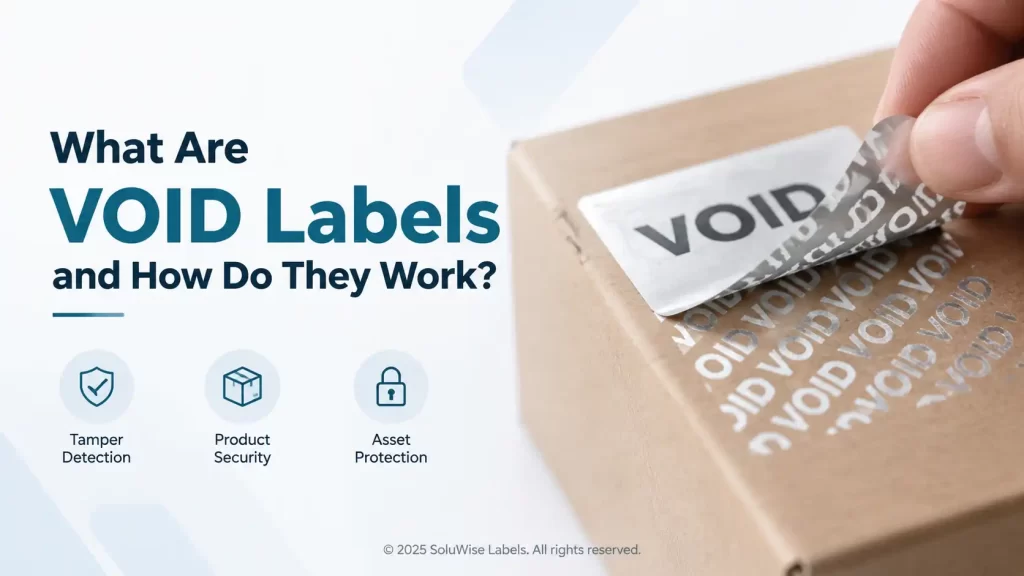
Choosing the right tamper-evident solution can be challenging, especially in the UAE where climate, packaging, and warranty practices vary across industries. VOID labels are a common answer for protecting product integrity, warranties, and security seals. They reveal tampering by showing a distinct pattern or message when a label is removed, helping businesses verify whether a product or package has been accessed since it left the factory or warehouse.
In this guide, you’ll learn what VOID labels are, how they work, and how to choose the right type for your UAE operation — whether you’re a retailer, manufacturer, hotel, laundries, logistics provider, or a facility with high-value equipment. We’ll also discuss practical considerations for surface compatibility, environmental exposure, and application practices, with a practical lens on SoluWise’s VOID label offerings in the UAE market.
Direct answer: What are VOID labels and why do they matter?
VOID labels are tamper-evident labels that intentionally reveal whether a surface has been opened or altered. When you apply a VOID label, attempting to remove it usually leaves a visible indication on the surface or on the label itself (for example, the word VOID or a similar pattern). This makes it clear if a seal has been broken, which is particularly important for protecting warranties, preventing counterfeit or unauthorized access, and tracking the integrity of packaging through the supply chain.
Across UAE industries such as electronics, cosmetics, foodservice, hotels, and manufacturing, VOID labels help deter tampering and provide a straightforward audit trail. They can be used on product packaging, warranty seals, appliance doors, access panels, and security closures — anywhere tamper evidence adds value to customer trust and brand protection.
Key factors to consider
Choosing the right VOID label depends on several practical factors. Below are the most important considerations for UAE-based operations:
1) Tamper-evidence mechanism
VOID labels come in several general approaches to reveal tampering. Some common patterns include a clear VOID imprint that remains on the surface after removal, or a residual pattern that transfers to the surface when the label is peeled away. The choice depends on how you want tampering to be detected and the surface material you are labeling.
2) Surface compatibility and material
Different substrates require different adhesives and label constructions. Smooth, clean surfaces such as metal, glass, and certain plastics typically yield reliable adhesion, while rough or textured surfaces may require more aggressive adhesives or pre-application surface preparation. In the UAE, consider whether the label will be exposed to heat, humidity, or cleaning agents, and select an adhesive that remains reliable under those conditions.
3) Environmental conditions
Environmental exposure influences label performance. Heat, humidity, UV exposure, and chemical cleaners can affect adhesive strength and the integrity of the VOID pattern. For storage in hot or humid UAE environments, look for labels designed for higher temperature ranges and moisture resistance while maintaining tamper-evidence performance.
4) Application and removal considerations
Single-use tamper-evident labels are designed to be difficult to remove intact. Some customers require a clean break that leaves evidence on the substrate; others may need a label that transfers a clean VOID pattern to the surface upon removal. Plan for the end-user workflow, including whether the item is opened at the point of sale, in a warehouse, or during service and maintenance.
5) Compatibility with printing and labeling systems
If you print VOID labels in-house, ensure the label stock is compatible with your printer type (for example, thermal transfer or direct thermal) and that the adhesive works with your printing surface. For higher-volume operations, consider label rolls or sheets that align with your existing barcode printing workflows to minimize handling time and waste.
6) Compliance, warranties, and brand protection
VOID labels can help protect warranties by signaling whether a product has been opened. They also support brand protection and counterfeit deterrence. However, they are one part of a broader security and compliance strategy. Always test on actual products and surfaces, and combine VOID labels with other controls as needed.
Detailed explanation and practical scenarios
To make this concrete, consider common UAE scenarios where VOID labels play a valuable role:
- <strongElectronics and appliances: Warranty seals on access panels or packaging where tamper evidence is essential. A VOID pattern on the label will indicate if a device was opened before sale or service.
- <strongPharma and cosmetics: Tamper-evident seals on packaging or bottles to deter counterfeit and ensure product integrity during transport and storage in warm climates.
- <strongHospitality and retail: Security seals on high-value equipment, retail display cases, or sensitive inventory that must not be accessed without authorization.
- <strongIndustrial and manufacturing: Seals on critical components, tool kits, or maintenance panels where tampering must be detected quickly in a busy facility.
- <strongLogistics and distribution: Tamper-evident closures on shipments and cartons to provide a visible tamper check at receiving docks or during cross-docking.
When evaluating VOID labels for UAE operations, perform a small pilot test with a few representative surfaces and environmental conditions. This helps confirm adhesion, legibility of the VOID pattern, and ease of removal or reapplication (if needed) before rolling out across a broader product line or facility.
Which option is right for you?
Deciding between different VOID label approaches depends on your application, volume, surface material, and how tamper evidence will be used in your workflow. Here are practical recommendations by common use cases:
- <strongSmall business or low-volume labeling: Use standard VOID labels on primary packaging or warranty seals. Choose a label with reliable adhesion to common packaging materials and a clear VOID imprint that is easy for staff and customers to recognize.
- <strongRetail and product packaging: For consumer-facing packaging, select VOID labels that render a prominent VOID pattern on attempted removal. Consider labels with a durable finish that withstood shelf life and handling in busy UAE environments.
- <strongWarehouse and high-turnover environments: Opt for durable adhesives and larger label areas to improve legibility and detection during quick scans or manual checks. Align labeling with your existing barcode printing workflow to maintain efficiency.
- <strongManufacturing and high-value items: Combine VOID labels with tamper-evident seals on critical components or access points. Ensure the adhesive is compatible with metal surfaces and equipment that may heat up during operation.
- <strongOutdoor or harsh environments: If labels face direct sun, salt air, or humidity, choose UV-resistant materials and adhesives designed for outdoor exposure to preserve tamper-evidence integrity.
Recommended SoluWise solutions for VOID labeling
SoluWise offers a range of tamper-evident VOID labeling options tailored for UAE businesses. Our approach emphasizes practical performance, surface compatibility, and easy integration with existing label and printing workflows. In addition to standard VOID labels, SoluWise provides customization options to createVOID labels that align with your brand and specific application needs.
<strongWhat this means for you: If you have a high-value product line, a complex warranty program, or a busy distribution network, SoluWise can help you select the right VOID label type and adhesive, and, if needed, develop custom VOID labels to fit unique surfaces or packaging formats. For more information, consider reaching out to SoluWise to discuss your requirements and obtain samples for testing. A practical starting point is to review our VOID label options and talk through your substrate, environment, and printing setup with a SoluWise specialist.
Common mistakes to avoid
- <strongIgnoring substrate compatibility: Applying a label to a rough or dirty surface can compromise adhesion and tamper evidence.
- <strongOverlooking environmental exposure: In UAE climates, UV, heat, and humidity can degrade some adhesives. Select materials designed for the expected operating conditions.
- <strongSkipping testing: Failing to test removal and reapplication (if necessary) on actual products limits your understanding of how tamper evidence will behave in real-use scenarios.
- <strongNot aligning with workflow: If labels slow down packing, distribution, or service processes, consider a more automation-friendly option or a smaller label footprint.
Frequently Asked Questions
- Q: What exactly is a VOID label?A: A VOID label is a tamper-evident label that reveals whether a surface has been opened or altered. When removal is attempted, the label or the surface shows a VOID pattern or text, signaling tampering.
- Q: Can VOID labels be reused after removal?A: In most cases, VOID labels are designed for single use. Removal typically destroys the tamper-evident effect, so reapplication would not provide the same security assurance.
- Q: Are VOID labels suitable for hot or humid environments?A: Yes, provided you select a label with an adhesive and substrate rated for the specific environmental conditions. In the UAE, this often means adhesives with good heat resistance and moisture tolerance.
- Q: Will a VOID label leave residue on removal?A: Many VOID labels transfer a visible VOID pattern to the surface or leave a residual mark. The exact behavior depends on the label construction and surface material.
- Q: Can SoluWise tailor VOID labels to my industry?A: Yes. SoluWise offers customization options, including material choices and adhesive formulations, to fit specific industry needs and packaging formats.
Final recommendation
VOID labels are a practical, low-friction way to add tamper evidence to packaging, warranties, and security seals for UAE-based operations. The key is selecting a label that matches your surface, environmental exposure, and workflow. Start with a pilot on representative products and surfaces, then scale up once you confirm adhesion, readability, and tamper-evidence performance. If you’re unsure which label material, adhesive, or application method is right for your needs, SoluWise can help you select the right combination based on your label size, printing volume, and operating environment. Reach out to discuss your specific application and get expert recommendations tailored to your UAE business.