
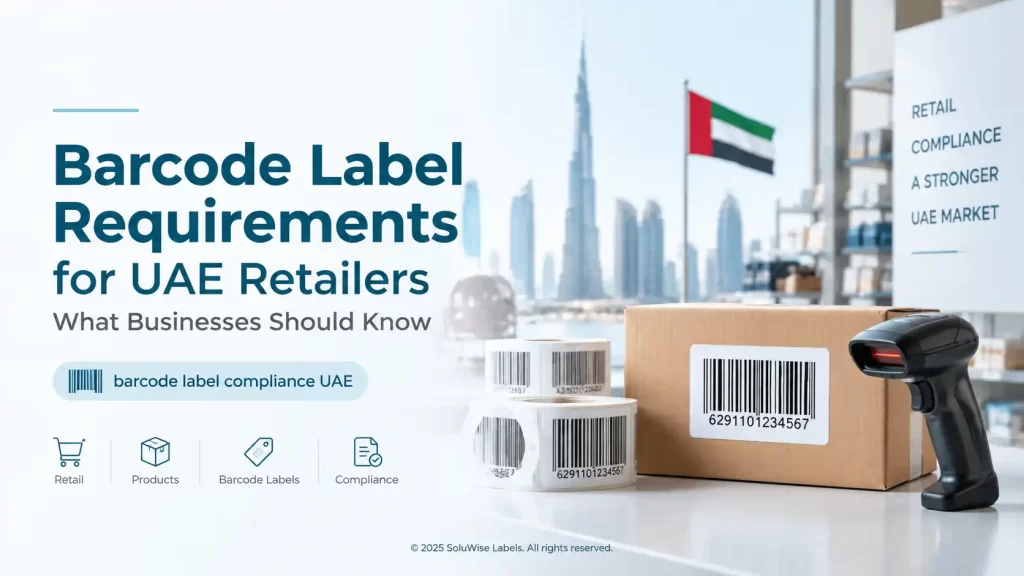
Retailers preparing new products for sale often discover that a barcode is more than a set of black lines on a package. Barcode Label Requirements for UAE Retailers: What Businesses Should Know starts with separating three related but different tasks: assigning a product identifier, printing a readable barcode and meeting the product-information rules that apply to the category being sold.
For most retail products, the practical priority is simple: use the correct product number, print it at a readable size and quality, and place it where scanners can capture it without covering mandatory package information. A label that scans at the warehouse but fails at the checkout counter creates delays, pricing disputes and unnecessary relabelling work.
Requirements can differ by product category, route to market and the authority involved. Food, cosmetics, supplements, chemicals and regulated consumer goods may have additional registration, labelling or approval obligations. Businesses should confirm category-specific requirements with the relevant UAE authority or retailer before printing large quantities.
Barcode Label Requirements for UAE Retailers: the practical starting point
A retail barcode normally represents a product identifier that is used in a retailer’s stock, pricing and point-of-sale systems. The barcode image itself is a machine-readable representation of that number. Printing a barcode label does not create the number, register the product or confirm compliance with GS1 or a government authority.
Where a retailer, distributor or marketplace requires GS1 identification, the business should obtain and manage its identifiers through GS1. The number should then be assigned consistently to the correct product variant. A different pack size, flavour, colour or unit configuration may need a different identifier, depending on the applicable GS1 rules and the trading partner’s requirements.
Once the number is correct, the label printer, material, ribbon and artwork must produce a barcode that can be read reliably. This is where many operational problems begin. A valid number can still fail to scan if the code is too small, poorly printed, curved around a pack or damaged during storage and handling.
Keep numbering, printing and registration separate
| Activity | What it means | Common misunderstanding |
|---|---|---|
| Product identification | Assigning the correct product number to a specific item or pack configuration. | Assuming a printed barcode creates a recognised product identifier. |
| Barcode printing | Producing a scannable symbol that represents the chosen number. | Assuming any black-and-white image will scan reliably. |
| Product registration or approval | Meeting any applicable category-specific registration, notification or authority process. | Assuming a GS1 barcode replaces regulatory requirements. |
| Retail system setup | Loading the item, price and product data into a retailer’s system. | Assuming a barcode automatically creates a checkout record. |
This distinction matters for purchasing teams. A label supplier can help select suitable label stock and produce labels from approved artwork, but the product owner remains responsible for confirming identifier ownership, artwork accuracy and applicable regulatory information.
Use GS1 standards where the retail channel requires them
GS1 standards are commonly used for retail product identification and barcode data sharing. For a packaged consumer item, a retail partner may request a GS1 barcode such as an EAN/UPC-style symbol. For outer cartons and logistics units, a different barcode and data structure may be appropriate.
Before ordering labels, confirm the barcode type requested by the retailer or distributor. Ask whether the label is for an individual retail item, a shelf-ready tray, a shipping carton or an internal warehouse location. These are different applications and should not automatically use the same barcode.
- Consumer unit: Usually scanned at point of sale and needs a clear, accessible barcode on the retail pack.
- Outer carton: Used for receiving and warehouse handling; it may need a larger label and a different identifier from the item inside.
- Internal location label: Supports stock movements and picking but is not a substitute for a product barcode.
- Promotional or variable-weight item: May follow retailer-specific numbering and data rules, so approval before print is particularly useful.
A practical check is to scan a pre-production sample using the same type of scanner likely to be used at receiving or checkout. This does not replace formal barcode verification where a trading partner requests it, but it can identify obvious print, contrast or placement issues before a full run.
Product information must remain readable and complete
Retail labels frequently carry more than the barcode. Depending on the product category and packaging format, they may need product name, ingredients, country of origin, net content, dates, batch details, importer information, storage instructions, warnings or Arabic information. The exact content and format should be confirmed for the product category rather than copied from another item.
Dubai Municipality requirements are often raised during food and consumer-product discussions, but businesses should avoid treating one checklist as universal. The authority, registration route and label-content requirements can vary by product type and where it is sold. A barcode should be positioned after the approved product artwork is finalised, not used as a reason to shrink mandatory text below a readable size.
For imported products, over-labelling can be useful where approved information must be added locally. However, the overlay label should not conceal dates, safety warnings, original traceability marks or the barcode that a retailer expects to scan. It also needs adhesive performance suitable for the package surface and storage conditions.
Barcode placement and quiet zones
Every barcode needs clear space around it, often called a quiet zone. Text, borders, graphics, folds and other barcodes placed too close can interfere with scanning. A barcode printed across a seam, a sharp curve or a highly reflective surface can also become difficult to read.
For example, a small cosmetics bottle may have limited room for an over-label. In that case, the label design needs enough width for both the barcode and its clear margins. Reducing the symbol until it barely fits may create a costly issue later at goods receiving or point of sale.
Choose label construction for the actual retail environment
Material selection is not only an appearance decision. A paper label may be appropriate for dry, short-life retail packaging, while a synthetic material may be more suitable for chilled storage, handling moisture, condensation or repeated abrasion. In UAE warehouses, labels may also be exposed to heat during receiving, vehicle loading or temporary storage.
Direct thermal labels can be practical for short-term variable information, such as carton routing or temporary warehouse labels. They can be unsuitable where labels will face heat, sunlight, friction or a long shelf life because the printed image can fade or darken. Thermal-transfer printing with a compatible ribbon is often considered where longer print durability is required, but the correct pairing depends on the label material and application.
SoluWise custom-size labels are relevant when standard dimensions do not leave enough room for the barcode, mandatory information or the package shape. They suit businesses that need labels cut for a particular bottle, carton, pouch, shelf edge or warehouse carton rather than forcing artwork into a generic size. The limitation is that custom sizing should follow a confirmed artwork layout and application test; a label size alone cannot solve an incorrect product number, poor barcode artwork or an unsuitable adhesive.
Common barcode compliance mistakes in UAE retail operations
- Reusing one barcode for different products. A new flavour, size or pack count can create stock and pricing errors if it shares an identifier with another sellable item.
- Printing from low-resolution artwork. A barcode copied from a screenshot, PDF preview or compressed image may have blurred bars and inconsistent edges.
- Making the barcode too small. Small packs create space pressure, but reducing symbol size can make scanning unreliable.
- Using poor contrast. Dark bars on a light, non-reflective background are generally easier for scanners than decorative colours, metallic films or transparent areas.
- Covering the code with an importer sticker. An over-label should be planned so the original code and any required information remain available where needed.
- Skipping real-world testing. A label may look clear on a desk yet fail after chilled storage, carton abrasion or handling in a busy receiving area.
- Confusing barcode printing with approval. A readable label does not confirm product registration, authority acceptance or retailer listing.
Pre-print checks for product barcodes
A short approval process can prevent a large relabelling exercise. Purchasing, operations and product teams should agree on the following before releasing labels to print:
- Confirm which product and pack configuration the barcode represents.
- Confirm the number and barcode format with the relevant brand owner, GS1 process or retail partner.
- Check the human-readable number below the barcode against the approved source data.
- Review barcode size, clear margins, contrast and placement on the final packaging artwork.
- Confirm that mandatory product information is present and unobscured for the relevant category.
- Test a representative printed sample after applying it to the real package.
- Check how labels behave in the expected storage and handling environment.
For carton labels, include the operational details needed by the warehouse without crowding the retail barcode. A receiving team may need a product description, quantity, batch or internal reference, while the retail item inside needs its own correctly assigned product barcode.
FAQ
Do all retail products in the UAE need a GS1 barcode?
Not every selling situation uses the same identification process. Many retailers and distributors request GS1-based identifiers for retail products, but the requirement should be confirmed with the intended trading partner and the applicable product category.
Can a business create its own product barcode number?
A business may create internal codes for its own warehouse processes, but a retail partner may require identifiers issued and managed through GS1. Internal numbering should not be assumed to meet an external retailer’s requirements.
Does printing a barcode label mean the product is registered?
No. Barcode printing, GS1 identification and product registration are separate activities. Any regulatory registration or approval depends on the product category and the relevant authority process.
What label material works for products stored in chilled areas?
The right material depends on the package surface, condensation level, temperature range and handling. Test the label on the actual pack, particularly if it will be applied cold or exposed to moisture.
Why does a barcode scan with one device but not another?
The barcode may be marginal in size, contrast or print quality. Different scanners and scanning distances can expose weaknesses, so testing with the intended operational equipment is useful.
A practical decision rule before ordering labels
Do not approve retail barcode labels until the product identifier, final artwork, label placement and application conditions have all been checked together. If the label must survive handling, refrigeration, heat or abrasion, test a production-like sample rather than relying on a screen proof.
For guidance on SoluWise custom-size labels, businesses can share their package dimensions, expected print volume, barcode format, printer compatibility and storage conditions. That gives the discussion a practical basis and helps identify a label format that suits the job.


