A security seal is only useful if tampering is obvious and difficult to hide. In the comparison of total transfer vs partial transfer VOID labels, the right choice depends mainly on the surface being sealed, the evidence required after removal and whether the label itself must retain a visible warning.
For most applications, total transfer labels suit situations where a permanent VOID message left on the item provides the strongest visual evidence. Partial transfer labels are often more suitable where both the package and the removed label need to show that a seal has been broken.
Both are forms of tamper evident labels. Neither is automatically right for every carton, device, bottle, enclosure or pallet. A sample test on the actual application surface is usually the most sensible step before a larger order.
Total transfer vs partial transfer VOID labels: the practical difference
VOID labels are constructed so that removal changes their appearance. Instead of peeling away as a normal label might, they leave a message, pattern or visible disruption that signals the seal has been lifted.
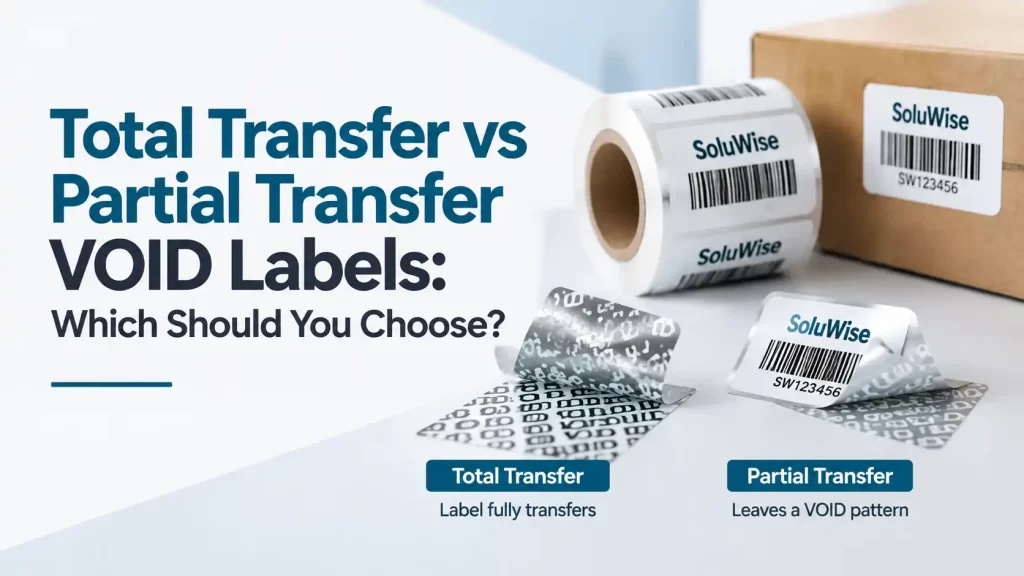
The difference lies in where that evidence remains after the label is removed. With total transfer, the transfer layer is designed to remain on the sealed surface. With partial transfer, part of the security indication remains on the surface and part remains with the lifted label.
| Feature | Total transfer VOID labels | Partial transfer VOID labels |
|---|---|---|
| After removal | A VOID indication is transferred to the sealed surface. | A VOID indication is visible on both the surface and the removed label. |
| Best evidence focus | Clear, permanent-looking evidence on the item or package. | Evidence on both sides of the attempted removal. |
| Visual appearance before removal | Usually appears as an intact security seal until lifted. | Usually appears as an intact security seal until lifted. |
| Typical uses | Cartons, enclosures, warranty seals and access points where the underlying surface can carry the transferred message. | Applications where retaining the peeled label for inspection may be useful. |
| Key selection check | Test whether the surface accepts a clear, consistent transfer. | Test whether both remaining and removed evidence is readable. |
How total transfer labels reveal tampering
A total transfer VOID label leaves the security pattern behind on the application surface once it has been lifted. The original label face may no longer carry the full message because the transfer layer has separated from it.
This makes total transfer a strong option for sealed cartons, equipment covers and product packaging where the recipient needs to see a clear message directly on the item. For example, if a warehouse receives a carton with a visible VOID pattern across its opening flap, staff can identify that the seal has been disturbed before accepting or dispatching the contents.
It can also suit electronics housings, access panels and asset enclosures, provided the material is compatible. A smooth, clean surface generally gives more consistent results than a dusty, textured or heavily coated one.
Advantages of total transfer
- The evidence remains directly on the protected surface.
- It gives a highly visible indication that a seal was lifted.
- It can discourage resealing attempts because the underlying surface is visibly marked.
- It is easy for receiving teams to inspect without needing the removed label.
Where total transfer may be unsuitable
Total transfer may not give predictable evidence on every substrate. Rough corrugated board, low-energy plastics, dusty packaging, oily metal or surfaces with loose coatings can affect adhesion and transfer performance. Heat and humidity can also influence label behaviour, so UAE warehouse conditions should be represented during testing where possible.
It may also be unsuitable where leaving a message on the item would be undesirable, such as a surface intended for resale, refurbishment or visual presentation after opening.
How partial transfer labels reveal tampering
Partial transfer VOID labels divide the evidence between the lifted label and the surface underneath. After removal, a VOID message or pattern appears on the item while part of the indication remains visible on the removed label.
This can be useful for controlled processes where the removed seal may be examined, attached to paperwork or retained as physical evidence. A service department opening a sealed unit, for instance, may want the enclosure to show it was opened while also retaining the removed label for an internal record.
The result is often more informative than a conventional label that simply tears or stretches. However, it still depends on correct material selection, surface preparation and application pressure.
Advantages of partial transfer
- It provides tamper evidence on both the sealed item and the lifted label.
- It can support inspection procedures where the removed label matters.
- It is suitable for applications needing a visible change without relying only on residue left behind.
- It can help distinguish an intact seal from one that has been removed and reapplied.
Where partial transfer may be unsuitable
Partial transfer is not a substitute for access control, product authentication or secure chain-of-custody procedures. It shows that a label has been disturbed; it does not identify who opened the package or prevent every possible form of interference.
As with total transfer, poor adhesion reduces the value of the security feature. If the label can lift at the edges because the surface is damp, dusty or uneven, the result may not provide the intended evidence.
Choose according to the surface and inspection process
The surface is often the deciding factor. Security labels should be tested on the actual carton coating, plastic case, metal panel or packaging film rather than on a substitute sample. A label that performs well on smooth painted metal may react very differently on recycled board or textured plastic.
For carton sealing, test across the opening seam and allow the label to settle under normal handling conditions before attempting removal. For equipment, test on the exact casing material, including any coating, texture or cleaning residue. For products stored in warm warehouses or moved between air-conditioned and humid areas, include those conditions in the assessment.
- Define what staff need to see after removal: evidence on the item, the label or both.
- Identify the substrate, including texture, coating, cleanliness and likely temperature exposure.
- Decide whether a residual VOID message is acceptable on the protected item.
- Apply sample labels using the normal production process and dwell time.
- Check for edge lift, readable transfer, clean removal behaviour and visibility from a normal inspection distance.
- Record the chosen material and application method so future batches are used consistently.
Recommended SoluWise VOID label options
VOID labels suit businesses that need a visible indication that packaging, stock, enclosures or equipment has been opened. They are appropriate for many general sealing applications, but the transfer type and adhesive behaviour should be matched to the surface rather than selected on appearance alone.
Custom VOID labels are a practical choice where label dimensions, layout, application position or security messaging must fit a specific process. They can be particularly useful where a seal must bridge a carton flap, fit a narrow device panel or support a defined receiving inspection. The application should still be tested because custom sizing does not remove surface compatibility issues.
Common mistakes that weaken tamper evidence
The most common mistake is choosing a transfer type before checking the application surface. A total transfer design may be preferred on paperboard, for example, but its visible result must be checked on the exact coating and print finish used for the carton.
Another issue is applying labels to contaminated surfaces. Dust, condensation, oil, release agents and loose fibres can reduce adhesion. In a busy packing area, cleaning and drying the application zone may matter as much as the label material itself.
Label placement also deserves attention. A tamper evident label should bridge the point of access, such as a carton flap, lid, enclosure seam or service opening. A seal placed beside the opening may remain intact even if the item can be accessed another way.
Finally, do not assume any damaged label proves malicious interference. Mishandling, friction during transport or unsuitable storage conditions can also cause damage. A clear inspection process helps teams distinguish accidental label damage from a broken seal.
FAQ
Which is more secure: total transfer or partial transfer VOID labels?
Neither is universally more secure. Total transfer places the strongest visual emphasis on the protected surface, while partial transfer gives evidence on both the surface and removed label. The better choice depends on how the seal will be inspected.
Can VOID labels be removed without showing evidence?
A correctly selected and applied VOID label is intended to show evidence when lifted. Actual performance depends on the substrate, surface condition, adhesive compatibility, temperature and application method, so testing is recommended.
Do total transfer labels leave residue on every surface?
No. Transfer behaviour can vary across cardboard, plastics, metals, coatings and textured materials. A sample test on the exact surface is the reliable way to assess the visible result.
Are partial transfer labels suitable for electronics?
They can be suitable for electronic enclosures and access panels where a broken seal needs to be visible on both the device and the removed label. The casing material, cleaning chemicals and operating heat should be considered before selection.
Can a VOID label replace serial-number tracking or asset records?
No. A VOID label indicates attempted removal or opening. Serial numbers, asset registers and documented inspection procedures serve different purposes and may be used alongside tamper evidence.
What details should be supplied when requesting custom VOID labels?
Share the application surface, label dimensions, position of the seal, expected environmental conditions, whether total or partial transfer is preferred, and how the item will be inspected after opening.
Before placing an order, test the chosen option under realistic packing, storage and handling conditions. A small trial can reveal edge lifting, weak transfer or an unreadable message before the label becomes part of a production process.