
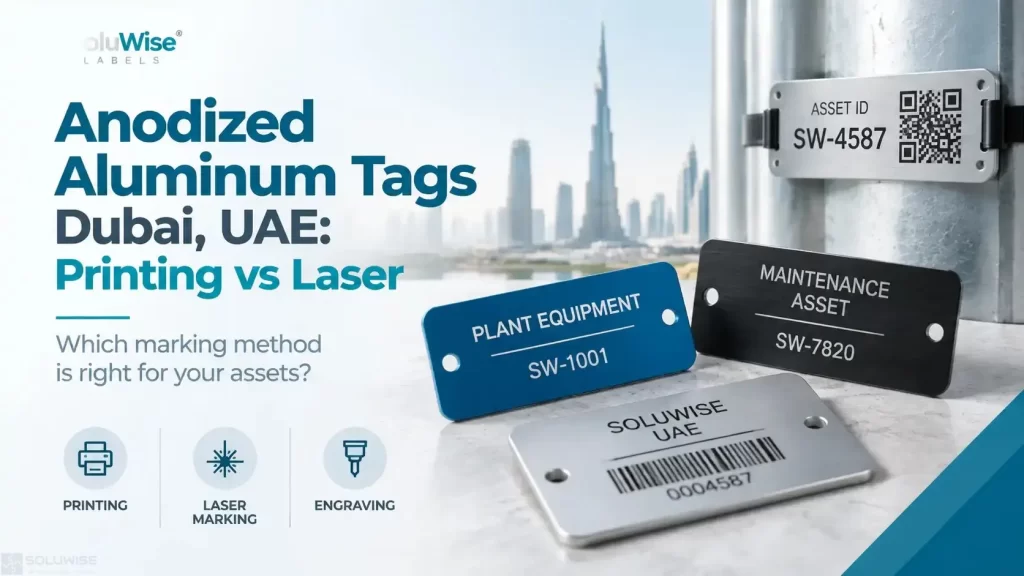
For equipment exposed to heat, sunlight, dust and frequent handling, anodized aluminum tags are often a practical choice. They provide a metal identification surface that can carry serial numbers, equipment details, barcodes and QR codes more durably than many paper or plastic labels.
The right tag is not selected by material alone. Performance in Dubai, Abu Dhabi and other UAE locations depends on the aluminum grade, anodizing quality, marking method, tag thickness, attachment method and the actual conditions around the asset. A tag on indoor IT equipment faces a very different environment from one fitted to a pump, generator, racking frame or construction plant outdoors.
Why anodized aluminum tags suit demanding identification work
Anodized aluminum is aluminum that has received an electrochemical surface treatment. The process creates a controlled oxide layer that is integrated with the metal surface. This layer improves resistance to surface wear and corrosion compared with untreated aluminum, while also creating a suitable surface for several identification methods.
For industrial asset tags in Dubai, anodizing can be useful because it helps the tag withstand routine cleaning, handling and exposure. It should not be treated as a universal answer to every environment, however. Salt-laden coastal air, chemical splash, abrasive cleaning, standing moisture and dissimilar-metal contact can all affect the finished tag and its fixing hardware.
A good specification considers the complete assembly: tag material and thickness, finish, marking, adhesive or fastener, installation surface and the information that must remain readable over time.
UAE conditions that affect metal tags
High temperatures and intense UV exposure are common reasons businesses move from ordinary printed labels to metal tags Dubai operations can rely on for fixed assets and outdoor equipment. Anodized aluminum does not fade in the same way as a conventional ink-only label, but the marking method still determines how long text and codes remain legible.
Humidity, airborne dust and cleaning routines also matter. Warehouses may be largely sheltered but still have open loading bays; utilities and construction equipment may see rain, dirt, vibration and direct sun; oil and gas or marine-adjacent work can introduce more aggressive contamination. The tag should be evaluated for its actual location rather than simply being described as “outdoor.”
Printing, engraving and laser marking on anodized aluminum
The strongest choice depends on what the tag needs to communicate and how it will be used. Printed metal nameplates can offer flexible layouts and colour, while engraved aluminum tags UAE users specify are valued for physically recessed information. Laser-marked aluminum tags Dubai businesses use can provide clear, high-contrast identification when the laser, anodized finish and artwork are correctly matched.
| Method | How it appears | Strengths | Limitations | Typical suitability |
|---|---|---|---|---|
| Printing | Ink or a printed coating on the tag surface | Flexible layouts, logos, colour coding and economical options for suitable environments | Surface print may wear or fade sooner under abrasion, harsh cleaning or prolonged outdoor exposure | Indoor equipment, controlled warehouses and nameplate applications where appearance matters |
| Mechanical engraving | Text and graphics cut into the metal | Information is recessed, resistant to rubbing and remains readable even if the surface becomes dirty | Less suited to intricate artwork or very dense variable data; appearance and cost depend on design | Outdoor equipment, industrial machinery and long-life identification |
| Laser marking | High-contrast mark created through a laser process | Fine detail, serialisation, compact barcodes and QR codes can be produced with a clean appearance | Contrast and durability vary with the anodized layer, laser settings and intended exposure | Asset tracking, detailed identification and applications needing machine-readable codes |
When printing is the sensible option
Printed metal nameplates suit applications where layout flexibility is important. They can be appropriate for indoor panels, controlled warehouse assets, branded equipment plates and labels containing instructions, warning text or colour-coded fields. For a short-to-medium-term indoor identification need, printing may provide an attractive result without the need for engraved detail.
Before choosing it for an exposed site, ask how often the tag will be rubbed, cleaned or exposed to direct sun. A printed finish that works well on an indoor cabinet may not be the right choice for a forklift, rooftop unit or exterior pump.
When mechanical engraving is preferable
Mechanical engraving is usually the conservative choice where abrasion is the principal concern. Because the identification is physically cut into the tag, the characters do not depend solely on a surface layer remaining intact. It is particularly useful for equipment IDs, serial numbers and basic asset information that must remain readable after years of handling.
Engraving may be less attractive for complex graphics or very small, dense machine-readable symbols. It also needs enough tag area and suitable character sizing to remain practical. A procurement team should confirm the intended text, code density and reading distance before committing to a small tag format.
How laser marking supports high-contrast asset identification
Laser marking on anodized aluminum can create sharply defined, high-contrast text, numbering and codes. This makes it a strong candidate for aluminum asset tags with serial numbers, particularly where technicians need to scan assets or read fine information at close range.
Results depend on the anodized coating, the laser type and process settings, and the artwork supplied. A dark anodized surface can often support a visually clear light mark, but no marking method should be selected on appearance alone. A representative sample should be assessed under the same lighting, dirt, scanning distance and handling conditions as the finished installation.
Choosing aluminum tags for the application
Tag thickness should match the size of the plate, mounting method and risk of bending. A small tag fixed to a flat indoor cabinet may not need the same rigidity as a larger tag fitted to vibrating plant or a curved outdoor housing. Thicker metal can resist deformation better, but it also affects cost, drilling and the fit of rivets or screws.
Dimensions should be driven by the data, not only the available mounting area. Leave adequate quiet space around barcodes and QR codes, provide readable text for technicians, and avoid trying to place a dense asset record on a very small tag. If a code must be scanned from a distance, a larger symbol may be needed than one scanned at arm’s length.
Serial numbers, barcodes and QR codes
A serial number gives each asset a unique identifier. A barcode or QR code can encode that number or another data value for faster capture by a scanner or mobile device. Printing or marking a code does not register it with GS1 and does not make the asset record part of any external registration system; the code must match the organisation’s own asset database and scanning workflow.
For outdoor metal labels UAE operations depend on, contrast is only one part of barcode performance. Module size, symbol type, available space, scanner capability, dirt accumulation and glare all influence readability. Test a proposed sample with the devices that will actually scan it. A code that looks crisp on a desk can fail if it is too small, mounted on a curved surface or viewed through reflective glare.
- Keep human-readable asset numbers alongside the code for manual checking.
- Use an appropriate symbol size rather than compressing a code to fit an undersized plate.
- Confirm that scanner hardware can read the chosen barcode symbology or QR code.
- Test codes after fitting, under site lighting and at the normal scanning angle.
- Consider a simplified identifier on harshly exposed assets and keep detailed records in the asset system.
Attachment methods are part of the specification
Screws and rivets provide a mechanical fixing suited to equipment that experiences heat, vibration, dust or outdoor exposure. They require holes in the asset or mounting bracket, so teams should check access, permissible drilling and the compatibility of the fastener material with the surrounding metal.
Adhesive backing avoids drilling and can be suitable for clean, smooth, low-stress surfaces. Adhesive performance is highly dependent on surface preparation, temperature, texture, contamination and exposure; it is not normally the first choice for heavily vibrating, oily or continuously exposed industrial equipment.
Cable ties are useful where drilling is unsuitable, such as temporary identification on pipes, cables, cages or movable equipment. They should be selected with the tag location in mind, since UV exposure, heat and abrasion can affect the tie even if the aluminum tag remains legible. For long-term industrial asset tags Dubai sites rely on, the attachment should be tested as carefully as the tag itself.
A practical selection guide for indoor, outdoor and industrial assets
| Application | Practical tag approach | Marking priority | Attachment consideration |
|---|---|---|---|
| Indoor IT assets and office equipment | Compact anodized aluminum asset tag where a metal label is required | Laser marking or suitable printing for serial and barcode data | Adhesive can be considered on clean, flat, protected surfaces |
| Warehouse racking, bins and handling equipment | Size the tag for readable numbers and scannable codes | Laser marking for detailed IDs; engraving for exposed high-contact points | Rivets or screws are often more secure where impact and handling occur |
| Outdoor plant, utilities and construction equipment | More rigid tag with a finish and marking method assessed for sun, dirt and abrasion | Engraving or validated laser marking | Mechanical fixing is generally preferable to adhesive alone |
| Manufacturing machinery | Custom anodized aluminum tag matched to machine space and maintenance practice | Engraving for enduring basic data; laser marking for dense serialised codes | Use fasteners suited to vibration and access for maintenance |
| Oil, gas or harsh process environments | Specify after reviewing chemical exposure, temperature and site procedures | Do not assume a standard finish is suitable without sample evaluation | Assess both tag and fastener for the complete operating environment |
Recommended tag options for SoluWise customers
Custom anodized aluminum tags are appropriate where dimensions, hole positions, finish and information layout need to match a specific asset or mounting location. They suit facilities teams that need a repeatable tag format across machinery, racks or fixed equipment. The limitation is that a custom layout needs clear artwork and application details before production.
Aluminum asset tags with serial numbers suit organisations that need a unique physical reference on each item. They are useful for audits, maintenance records and handover processes. The serial format should be planned around the asset system, because changing numbering conventions later can create confusion.
Laser-marked aluminum tags are a sensible option for fine text, serialised information, barcode data and QR codes where a high-contrast result can be validated. They are not automatically the right option for every aggressive environment; sample testing remains advisable for exposed or chemical-prone installations.
Barcode and QR code asset tags suit warehouses, logistics operations and maintenance teams that scan assets. They should be chosen only after confirming code size, contrast, scanner compatibility and real-world scanning conditions. Industrial identification labels may be more suitable than metal where the surface is irregular, the item is temporary or a flexible label format is required.
Common specification mistakes to avoid
- Choosing only by appearance: a polished or coloured finish may look good initially but still be unsuitable for abrasion or site chemicals.
- Making codes too small: dense QR codes and narrow barcode bars are harder to scan after dirt, glare or wear are introduced.
- Using adhesive without assessing the surface: dust, oil, textured paint and heat can compromise adhesion.
- Ignoring mounting access: a tag may be correctly specified but difficult to rivet or screw once the equipment is installed.
- Using the same tag everywhere: one format rarely suits sheltered IT assets, warehouse equipment and exposed industrial plant equally well.
Frequently asked questions
Are anodized aluminum tags weather resistant?
They can be a good choice for weather-exposed identification because anodizing improves the aluminum surface’s resistance to corrosion and wear. Actual service depends on the finish, marking method, fastener, UV exposure, abrasion, salt and chemical conditions.
How long do anodized aluminum tags last outdoors in the UAE?
There is no reliable single lifespan for every installation. A sheltered tag with limited contact can perform very differently from a tag on vibrating outdoor machinery exposed to direct sun, dust, cleaning and coastal air. Site-specific sample assessment is the sound basis for an expected-life decision.
Is engraved or laser-marked aluminum better for outdoor use?
Engraving is often preferred where physical abrasion is expected because the information is recessed. Laser marking can be excellent for high-contrast detail and codes, provided the anodized surface and laser process are suitable for the intended environment. The better option depends on exposure and the amount of data required.
Can barcodes be placed on aluminum asset tags?
Yes, provided the code is large enough, has adequate contrast and is tested with the intended scanner. Include readable text as a backup, especially where dirt, glare or damage could affect scanning.
Will adhesive-backed aluminum tags work on industrial equipment?
They may work on clean, smooth, stable surfaces in suitable conditions. For equipment exposed to vibration, oil, dust, outdoor heat or rough handling, screws or rivets are generally a safer option after checking the installation constraints.
Choose the marking method before finalising the tag layout
A practical rule is simple: use printing for protected applications where flexible presentation is the priority, choose engraving where abrasion resistance and basic long-term readability matter most, and consider laser marking for detailed, high-contrast serialisation and machine-readable codes. Then select the tag size and attachment method around the site conditions.
Businesses in Dubai and across the UAE can contact SoluWise with their asset type, mounting surface, required information, scanning method and exposure conditions. That information makes it easier to assess suitable custom anodized aluminum tags, metal nameplates or industrial identification labels without over-specifying the job.


